Course contents
Payoff at expiry
A payoff diagram shows an option's profit or loss at expiry across every price of the underlying. A long call has capped loss and open-ended gain; a long put, capped loss and a large bounded gain.
- Read the payoff diagram of a long call and a long put
- Define breakeven and locate it for each
- Connect the payoff shape to capped loss and open-ended gain
The clearest way to understand any option is to draw what it is worth at expiry across every possible price of the underlying. That single picture, the payoff diagram, tells the whole story at a glance: where you lose, where you break even, where you profit, and by how much.
The payoff diagram
A payoff diagram plots the price of the underlying at expiry along the horizontal axis, and your profit or loss along the vertical axis. It shows the outcome at expiry only, the finish line, not what happens along the way. Because at expiry an option is worth just its intrinsic value, the diagram is easy to draw once you know the strike and the premium you paid.
The long call
Take a long call, the right to buy at the strike, bought for a premium.
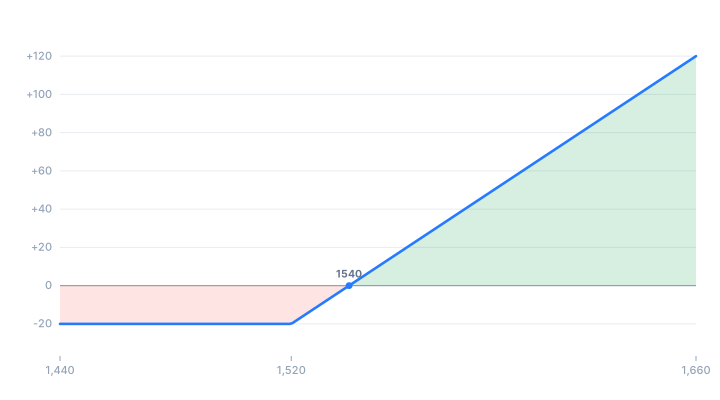
Below the strike at expiry, the call is out-of-the-money and worthless, so you simply lose the premium. On the diagram this is a flat line sitting at minus the premium, the same small loss across a whole range of low prices.
Above the strike, the call gains intrinsic value one rupee for every rupee the price rises, so your loss shrinks, reaches zero, and turns into profit. The point where you break even is the strike plus the premium, because you must first earn back what you paid. Beyond that, profit rises with the price, in principle without a ceiling.
So a long call has a capped loss, the premium, and an open-ended gain, with breakeven at strike plus premium.
The long put
A long put, the right to sell at the strike, is the mirror.
Above the strike at expiry, the put is worthless and you lose the premium, a flat line at minus the premium. Below the strike, the put gains value as the price falls, one rupee for each rupee down. Breakeven is the strike minus the premium. Below that you profit, and the profit keeps growing as the price falls, though it cannot be unlimited, because the price can fall no lower than zero. So a long put has a capped loss, the premium, and a large but bounded gain, with breakeven at strike minus premium.
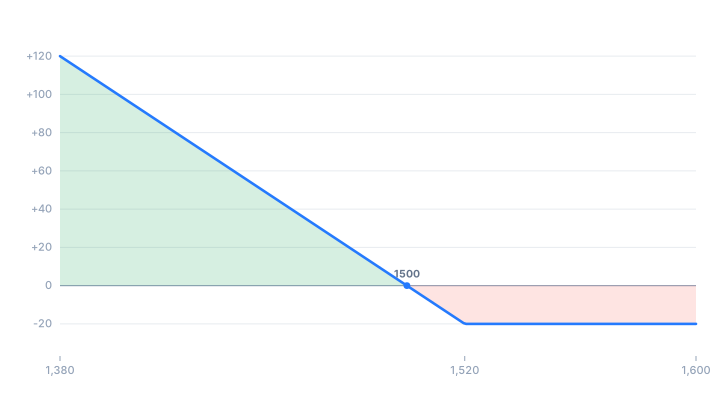
The two diagrams are the buyer's deal from an earlier chapter, drawn out: a small, fixed loss on one side, a large potential gain on the other. The picture also makes the trade honest, because it shows just how far the price has to travel, past breakeven and not merely past the strike, before the buyer earns anything.
What to carry forward
The payoff diagram draws an option's profit or loss at expiry across every price of the underlying, and it lays the buyer's deal bare. A long call loses only the premium below its strike and profits without a fixed ceiling above breakeven, which sits at strike plus premium. A long put loses only the premium above its strike and profits as the price falls below breakeven at strike minus premium. The lesson hiding in both pictures is that the underlying must travel past breakeven, not merely past the strike, before you make anything.
But this is the expiry picture only. Before expiry, your profit and loss can look very different, and the next chapter explains why.