Course contents
Premium, strike, and expiry
Every option carries a premium you pay, a strike you lock, and an expiry you race, all written on an underlying. You can read them straight off an Indian option name.
- Define strike, expiry, premium, and underlying precisely
- Read a full Indian option symbol piece by piece
- Understand how the three numbers frame every idea to come
Every option, call or put, comes stamped with three numbers, and once you can read them you can read the option. They are the premium, the strike, and the expiry, and they sit on top of a fourth thing, the underlying the option is written on.
The three numbers, and the thing beneath them
The strike is the fixed price at which the option lets you act: the price a call lets you buy at, or a put lets you sell at. It is chosen when the option is created, and it does not change.
The expiry is the date the right ends. On and up to that date the option is alive, and after it the right is gone and the option ceases to exist. Indian options come with weekly expiries and monthly expiries, so you can choose how much time you are buying.
The premium is the price of the option itself, paid by the buyer to the seller, and quoted per share of the underlying. It is what the option costs, and for a buyer it is the most that can be lost.
The underlying is the stock or index the option is written on, such as Infosys or the Nifty index. Everything the option is worth flows from what the underlying does.
Reading an option by its name
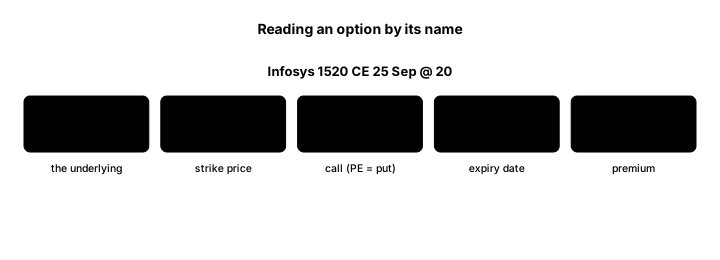
Indian option names pack all of this into a short string. Read this one piece by piece:
INFY 25 SEP 1520 CE
INFY is the underlying, Infosys. 25 SEP is the expiry, the date the right ends. 1520 is the strike, the price the option lets you act at. CE marks the type, a call. So the whole name says: the right to buy Infosys at 1,520, expiring on the twenty-fifth of September. Swap CE for PE and it becomes the right to sell at 1,520 by the same date. Once you can decode the name, the option holds no mystery.
These three numbers frame every idea still to come. The premium is your cost and your maximum loss as a buyer. The strike decides where the option starts to have real worth. The expiry sets the clock ticking against you. Moneyness, payoff, and time decay, the subjects of the next chapters, are all just consequences of these three.
What to carry forward
An option is framed by three numbers on top of an underlying: the premium you pay, the strike you lock, and the expiry you race. You can read all of them directly from an Indian option name, such as INFY 25 SEP 1520 CE. These three drive everything ahead, because moneyness, payoff, and the melting of time value are all just the working out of the premium, the strike, and the expiry. Remember that the premium is per share while you pay for a whole lot, a point the next part makes concrete.
There is one more foundation to lay before reading an option's value. Every option has two sides, a buyer and a seller, and their positions are mirror opposites. The next chapter looks at both.