Course contents
Value borrowed from something else
A derivative is a contract whose value comes from an underlying asset. People use derivatives to hedge risk, to speculate, and to help set prices.
- Define a derivative in plain terms with an everyday example
- Name the main types of derivative and place options as the sibling course
- Explain the three honest uses, hedging, speculation, and price discovery
Imagine you run a company that fries and sells potato chips. Your whole business depends on one thing you do not control: the price of potatoes. When the crop is poor and potatoes climb from 20 rupees a kilo to 30, your costs jump and your profit vanishes. So you make an arrangement with a farmer. You agree today that in three months, at harvest, you will buy ten tonnes of potatoes from him at 20 rupees a kilo, whatever the market price turns out to be.
That agreement now has a value of its own, and that value moves with the potato price. If potatoes rise to 30 by harvest, your right to buy at 20 is worth a great deal. If they fall to 15, the same agreement is a burden, because you have promised to pay more than the market. The agreement is not potatoes. It is a contract whose worth is borrowed from potatoes. That borrowed-value contract is a derivative, and this course is about the most important one for a trader, the future.
The idea, named
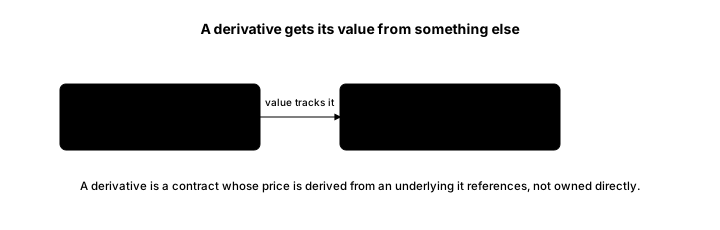
A derivative is a contract whose value comes from, or is derived from, the price of something else. That something else is called the underlying. In our story the underlying is potatoes and the derivative is the agreement to buy them at a fixed price.
The underlying can be almost anything with a price that moves. It can be a commodity like potatoes, gold, or crude oil. It can be a single share like Reliance. It can be a market index like NIFTY, which you met in Stock Market Basics as a single number standing for the whole market. It can even be a currency rate like the rupee against the US dollar. Whatever the underlying, the derivative's price rides on it: when the underlying moves, the derivative moves.
This is the one idea to hold on to. You are no longer trading the thing itself. You are trading a contract that tracks the thing. That small shift, from owning an asset to holding a contract about it, is what makes derivatives so useful and so easy to misuse.
The family of derivatives
Derivatives come in a few main types, and you have already met one of them.
A forward is the plain agreement in our potato story: two parties privately fix a price today for a deal on a future date. It is the oldest derivative, and the next chapter takes it apart.
A future is a forward that has been standardised and made safe to trade on an exchange. It is the subject of this course.
An option, which the Options Basics course covered in full, is the right, but not the obligation, to buy or sell at a fixed price. The difference from a forward or future is that word right: an option holder can walk away, while a forward or future binds both sides to go through with the deal.
A swap is an agreement to exchange one stream of payments for another, for example a floating interest rate for a fixed one. Swaps are mostly the territory of banks and large companies, so this course only names them and moves on.
For a beginner in the Indian market, two of these matter most: futures, which you are about to learn, and options, which you may already know. They are close cousins, and a later chapter compares them directly.
The three honest reasons derivatives exist
Derivatives can feel abstract until you ask what they are actually for. There are three real answers, and being clear-eyed about which one you are using is the beginning of trading them well.
The first is hedging, which is simply insurance. Our potato-chip maker was hedging: locking a buying price to protect against a rise it could not afford. On the other side, a farmer worried that prices might fall can lock a selling price to protect his income. Neither is trying to get rich on the deal. Each is removing a risk it already carries. This is the original and most respectable use of derivatives.
The second is speculation, which is taking a position purely to profit from a price move, without any underlying business to protect. A trader who thinks NIFTY will rise can buy a NIFTY future and gain if it does, without ever owning a single share. Most retail derivative activity is speculation, and because derivatives usually come with leverage, a small deposit controlling a large position, this is also where most of the losses happen. The course will be honest about that throughout.
The third is price discovery. Because so many people express their views through futures, the futures price becomes a running summary of what the market expects the underlying to be worth in the near future. That shared signal helps everyone, hedger and speculator alike, see where prices are heading.
What to carry forward
A derivative is a contract whose value is borrowed from an underlying, be it potatoes, a share, an index, or a currency. Its family includes forwards, futures, options, and swaps, and for you the two that matter are futures and their cousin, options. People use derivatives to hedge a risk they already have, to speculate on a price move, or to read the market's expectations through price discovery, and the honest trader always knows which of the three they are doing. The next chapter goes back to the oldest derivative of all, the forward, because once you see the two problems a private forward has, the entire design of the futures market falls into place as the fix.