Course contents
A straight line, both ways
A future's payoff is a straight line, you gain or lose one for one with the underlying, without limit in either direction, and with no premium and no time decay.
- Draw the linear futures payoff
- Contrast it with an option's bent payoff and the option buyer's capped loss
- State plainly that a future has unlimited profit and unlimited loss and no time decay
You have already seen a future's payoff, though under a different name. Back in Chapter 2, the forward's payoff was a plain straight line: the buyer gained one rupee for every rupee the price rose and lost one for every rupee it fell. A future is a forward made safe, so its payoff is that very same line. This short chapter draws it clearly and sets it beside an option's payoff, because the difference between the straight line and the bent one is the difference between the two great families of derivatives, and it tells you exactly what a future gives you and what it takes.
The straight line
Take the long NIFTY future from the last chapter, bought at 24,000 on a lot of 65. Plot your profit and loss against where NIFTY finishes, and you get a single straight line passing through zero at 24,000. Every 100 points up is 6,500 rupees of profit; every 100 points down is 6,500 rupees of loss. The line climbs to the right without ever levelling off, and falls to the left without ever finding a floor. (All figures illustrative.)
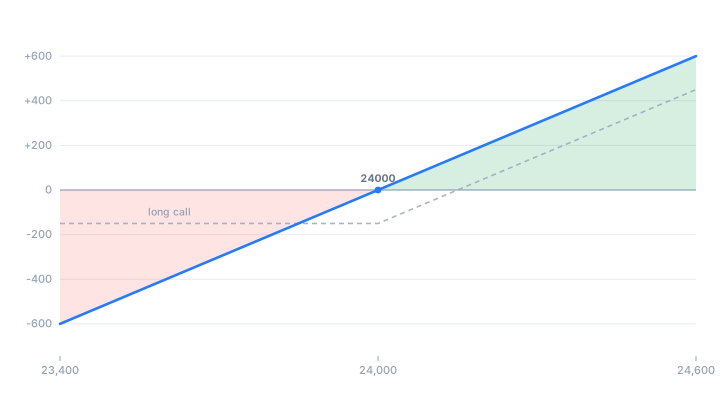
There is no bend anywhere in that line, and this is the whole character of a future in one picture. There is no strike price at which the behaviour changes, because a future has no strike. There is no flat floor of capped loss, because you paid no premium to buy protection. And there is no ceiling, because your gain is not capped either. A short future is the same line reflected, sloping down: profit to the left as the price falls, loss to the right as it rises, both open-ended. Straight, symmetric, and unbounded on both ends.
Against the option's bend
Now lay a long call's payoff over it, the one you met in Options Basics. The call's line is bent. Below its strike it is flat, sitting at a small fixed loss, the premium and no more, because the most a call buyer can lose is what they paid. Above the strike it turns and climbs. That bend is the option buyer's safety: a floor under the loss, bought and paid for with the premium.
The future has no such bend and no such floor. Where the call buyer paid a premium to cap the downside, the future holder pays nothing and caps nothing. The trade is stark. A future gives you the full move in your favour with no premium to earn back, and in exchange it hands you the full move against you with no floor to catch you. The option buyer bought a cushion; the future holder chose to go without one.
No premium, and no clock
The straight line carries a second, quieter consequence that is a genuine advantage of futures. Because there is no premium and no time value in a future, there is no time decay. An option buyer, you will recall, loses a little every day as time value melts, and must beat that bleed to profit. A futures holder faces none of it. A future's price does drift toward the spot price as expiry nears, for the cost-of-carry reason Chapter 11 explains, but it does not rot the way an out-of-the-money option does. Hold a correct directional view in a future and the clock is neither friend nor enemy; hold the same view in a long option and the clock is quietly against you the whole time.
This is why a trader with a clean directional conviction, and the discipline and capital to handle the risk, sometimes prefers a future to a bought option: no premium to pay, no decay to fight, and a clean one-for-one move. The price of that cleanliness is the missing floor.
What to carry forward
A future's payoff is the forward's straight line: one-for-one both ways, no cap, no floor, symmetric for long and short. Set against an option's bent payoff, the difference is plain, the option buyer paid a premium for a floor under the loss, while the future holder pays nothing and has no floor at all. In return the future carries no time decay, so a correct directional view is not fighting the clock, which is its real edge over a long option. But the missing floor is the missing floor, and it is exactly why Part 3 now turns to the three mechanics that decide how that straight line actually plays out in your account: leverage, margin, and daily settlement.