Course contents
Choosing between the two derivatives
A future and an option can express the same view, but very differently. The future is linear with no decay yet unlimited risk, while a bought option caps the buyer's loss but bleeds time value. Learn when each fits.
- Compare a future and an option on risk, cost, time decay, and margin
- Recall that a long call plus a short put equals a future, the synthetic from the options course
- Give a plain rule of thumb for when each suits a view
You are bullish on NIFTY. You can buy a NIFTY future, or you can buy a NIFTY call option. Both will make money if NIFTY rises, so which should you choose? The honest answer is that they are very different trades wearing the same directional clothing, and choosing between them is really a choice about how you want to carry the risk. This chapter, the last of the working part, sets the two families side by side, so that a reader of both this course and the options courses can pick the right tool rather than defaulting to a favourite.
Four differences that matter
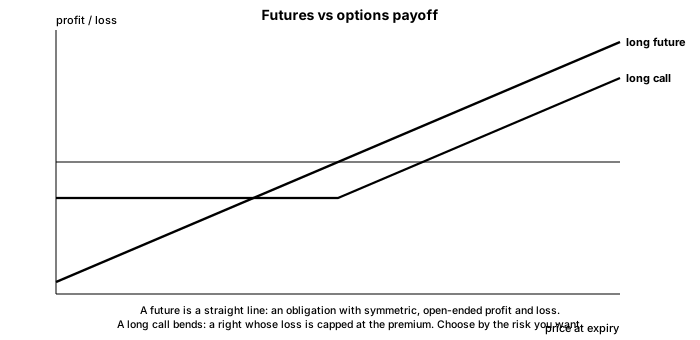
Line a plain bought call up against a NIFTY future for the same bullish view, and four differences decide everything.
Risk. A future has unlimited risk on both sides, the straight line with no floor. A bought option has a floor: the most the buyer can lose is the premium, no matter how far the market moves against them. For a directional bet, the bought option's capped, nameable loss is the gentler risk, which matters most for a beginner.
Cost. A future charges no premium; you post margin, which is a returnable deposit. A bought option costs a premium, real money paid and gone, the price of that capped-loss floor. So the future is cheaper to enter and the option makes you pay for its safety.
Time decay. A future does not decay; its price only drifts toward spot through carry, and a correct directional view is not fighting the clock. A bought option loses time value every day, so it must move far enough and soon enough to beat that bleed. On a slow-moving view, the future's lack of decay is a real edge.
Margin. A future ties up a large margin, the SPAN plus exposure of Part 3, and exposes you to margin calls and daily mark-to-market. A bought option ties up only the premium, with no margin call to the buyer, because there is nothing more to lose than what was already paid. An option seller, by contrast, does post margin, like a future.
Put together in a table:
| NIFTY future | Bought NIFTY call | |
|---|---|---|
| Loss | Unlimited, no floor | Capped at the premium |
| Upfront | Margin (returnable deposit) | Premium (paid, gone) |
| Time decay | None | Bleeds every day |
| Margin calls | Yes, daily M2M | No, for the buyer |
| Payoff shape | Straight line | Bent, one-sided |
They are two views of one thing
For all their differences, futures and options are deeply related, and the options course showed exactly how. Recall put-call parity: a long call plus a short put at the same strike equals being long the underlying, a synthetic future. So a future can be built out of options, and an option position can be decomposed into a future plus the missing piece. The bought call, in fact, is a future with the downside chopped off and paid for with the premium. Seeing them this way makes the choice concrete: the option buyer paid a premium to saw the loss-making half off the future's straight line, while the futures trader kept the whole line and kept the premium.
A plain rule of thumb
None of this makes one instrument better than the other; each fits a different view and a different tolerance for risk. A few plain rules help you choose.
Reach for a future when you have a strong, timely directional conviction, want a clean one-for-one move with no premium to earn back and no decay to fight, and, crucially, have the capital and the discipline to manage the unlimited risk, the margin, and the daily settlement.
Reach for a bought option or an option spread when you want a loss you can name and cap before you enter, when you are willing to pay a premium and beat time decay for that safety, or when you want an asymmetric payoff that a straight line cannot give. For most beginners, most of the time, this defined-risk route is the gentler one, precisely because the worst case is written down in advance.
Reach for options when you want to sell premium or build the neutral and volatility structures of the strategies course, which futures simply cannot express, because a future has only the one straight shape.
And for hedging, either can serve: a futures short gives a clean linear hedge that removes both downside and upside, while a bought put gives a floor under a holding while keeping its upside, for the cost of the premium. Which you choose depends on whether you want to freeze the position or insure it while staying in the game.
What to carry forward
A future and an option can voice the same view but carry it differently: the future is a straight line, no premium, no decay, unlimited risk, large margin; the bought option is a bent line, a premium paid, daily decay, but a loss capped at that premium. Put-call parity ties them together, a long call plus a short put is a future, so the bought call is simply a future with its losing half sawn off and paid for. Choose the future for a clean, high-conviction, well-managed directional bet, and a bought option or spread when you want your worst case named in advance, which for a beginner is usually the wiser default. With the working uses of futures complete, the final part returns to the danger the course opened with, leverage, and how to trade futures without being destroyed by it.