Course contents
When the deposit runs low
If daily losses eat into your margin, the broker asks you to top it up, a margin call, and if you do not, your position is squared off, often at the worst moment. Understand it before it happens to you.
- Explain how mark-to-market losses trigger a margin call
- Describe a forced square-off and why it tends to come at a bad price
- Give the guardrails, a margin buffer and smaller position sizing, that keep you clear of it
The last chapter left you with a position whose losses are taken out in cash every evening. This chapter follows that thread to its hard end. When the daily debits have eaten far enough into the deposit you posted, the broker cannot let you carry the position any longer without more money, and it asks for it, or it closes you out. That moment is the margin call, and it is the single most common way a futures trade ends, not by the trader's choice but by the mechanics catching up with them.
How the call happens
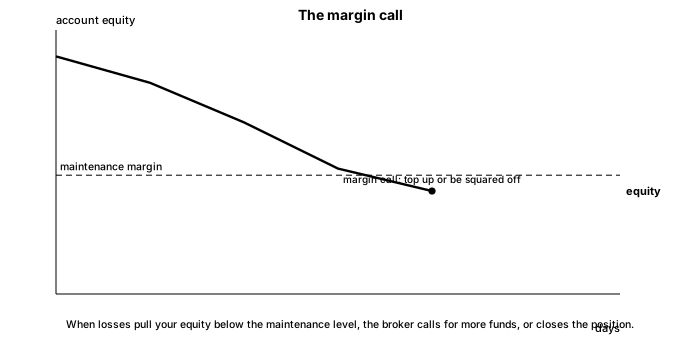
Recall the two numbers. To hold one lot of NIFTY futures you must keep the initial margin, about one lakh fifty-six thousand rupees, in your account. Mark-to-market debits your losses nightly. Put those together and the danger is obvious: if losses pull your account balance below the required margin, you are short of what the exchange demands, and something has to give.
At that point the broker issues a margin call, a demand that you add funds to bring your balance back above the required margin. If you add the money, the position continues. If you do not, or cannot, in the short time given, the broker squares off your position for you, selling your long or buying back your short to close it. This is a forced square-off, and it is done to protect the broker and the clearing corporation, not you.
Watch how little it takes if you funded the account carelessly. Suppose you deposited exactly one lakh fifty-six thousand, the bare margin, with nothing spare, and went long one lot at 24,000. The very next day NIFTY falls 1%, about 240 points, an utterly ordinary move. Mark-to-market debits 240 times 65, which is 15,600 rupees, and your balance drops to about one lakh forty thousand, now below the required margin. A single 1% down day, and you are already on a margin call. (All figures illustrative.) This is why a bare-minimum account is a trap: it has no room to breathe.
Why the forced exit hurts
A forced square-off is painful for a reason beyond the loss itself. It happens at the worst moment, by design. Your position is closed precisely when the market has moved hard against you, which means you are crystallising the loss at or near the low point of your trade, with no say in the timing. If the market then recovers, as it often does, you are no longer in the position to benefit. The mechanics sold you out at the bottom.
Worse still is the gap. A future cannot be stopped or closed while the market is shut, so if bad news breaks overnight or over a weekend, NIFTY can open 2% or 3% away from where it closed, and the mark-to-market debit for that whole move lands at once. If the loss is larger than the balance you had, your account goes negative: you now owe the broker money, having lost more than the deposit you posted. This is the concrete meaning of a warning from earlier chapters, that with a future you can lose more than you put up. The margin was sized for a normal day, and a gap is not a normal day.
The guardrails
The margin call is not bad luck. It is the predictable result of two choices a trader controls, and reversing them is most of what keeps a futures account alive.
The first guardrail is a cash buffer. Never fund your account with only the bare margin. Keep a balance well above what the position requires, so that ordinary losing days debit your buffer rather than breaching the margin. A trader holding a position that needs one lakh fifty-six thousand of margin might keep four or five lakh in the account, so that even a rough few days does not trigger a call. The buffer is not idle money; it is what lets you hold a correct view through the noise.
The second guardrail is position size. The surest way to survive leverage is to use less of it than the margin allows. Holding one lot when your capital could technically support three means an adverse move costs a third as much of your account, and a margin call becomes a distant risk rather than a daily one. Almost every futures blow-up is really a position-size mistake wearing a market-move disguise.
Two smaller habits help. Using a stop-loss during market hours can cap a loss while you can still act, though remember a gap jumps straight past a stop. And trimming or closing positions before big scheduled events, when a large move is more likely and margins are raised anyway, keeps you out of the worst of the gap risk.
What to carry forward
A margin call is the mechanics of Part 3 catching up with a trade: leverage set the size, mark-to-market drained the cash nightly, and when the balance fell below the required margin the broker demanded a top-up or closed the position, often at the worst possible price. A bare-margin account can be called on a single ordinary down day, and an overnight gap can take more than you deposited, leaving you in deficit. The two guardrails, a generous cash buffer and a deliberately small position, are what keep an account clear of all this, and they will return as the heart of Part 6. With leverage, margin, and daily settlement now understood, Part 4 steps back to the calmer questions of how a future is priced, why it rarely sits exactly at the spot price, and what happens when it finally expires.