Course contents
Settled every single day
A future is settled to the market every day. Each evening the day's profit is credited to your account or the day's loss is debited from it, so gains and losses are real cash daily, not paper until expiry.
- Explain mark-to-market daily settlement with a multi-day worked example
- Explain why settling daily removes the risk of a counterparty defaulting
- Show that a loss becomes real cash the same evening, not at expiry
A share you buy just sits there. Its price rises and falls, and your profit or loss is only on paper until the day you sell. A future does not work that way. While you hold it, the exchange reaches into your account every single evening and settles the day's result in cash: crediting your profit, or debiting your loss, that night. This daily reckoning is called mark-to-market, and it is the mechanism that makes a losing futures position feel so different, and so much more urgent, than a losing share.
What mark-to-market means
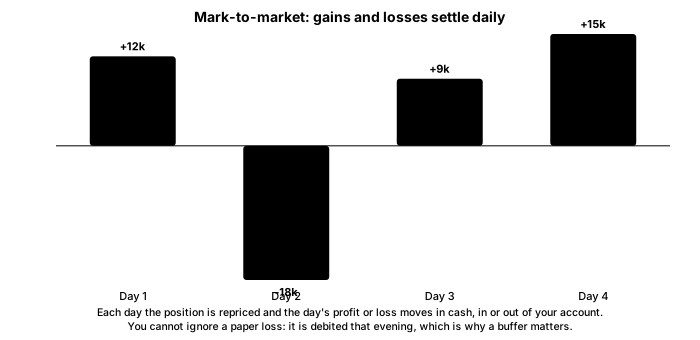
Mark-to-market, often shortened to M2M, is the daily settlement of a futures position to the closing price. At the end of each trading day the exchange takes the day's settlement price, compares it with the price your position was carried at, and moves the difference in or out of your account in cash. Your position is then carried forward at the new price, ready to do the same again tomorrow.
The key word is cash. This is not a paper number that waits for expiry. If you lost money today, that money is actually debited from your account this evening. If you made money, it is actually credited, and you could withdraw it. Every day your position is, in effect, closed at the day's price and reopened at it, with the difference settled for real.
A worked week
Take a long position of one lot of NIFTY futures, bought at 24,000, with a lot of 65, and follow it for three days. (All figures illustrative.)
| Day | Day's close | Carried from | Daily M2M | Cumulative |
|---|---|---|---|---|
| 1 | 24,100 | 24,000 | plus 6,500 | plus 6,500 |
| 2 | 23,900 | 24,100 | minus 13,000 | minus 6,500 |
| 3 | 24,050 | 23,900 | plus 9,750 | plus 3,250 |
On day one NIFTY rose 100 points from your entry, so 100 times 65, which is 6,500 rupees, is credited to your account that evening, and your position is now carried at 24,100. On day two it fell to 23,900, a drop of 200 points from where it was carried, so 13,000 rupees is debited that evening, and the position is carried at 23,900. On day three it recovered to 24,050, a rise of 150 points from 23,900, so 9,750 is credited.
Add the three daily settlements and you get plus 3,250 rupees. Notice that this is exactly 50 points, the difference between the final 24,050 and your entry 24,000, times 65. The total over the life of the trade always equals the final price minus your entry, just as you would expect. Mark-to-market does not change how much you make or lose in the end. It changes when the money moves. Instead of one settlement at the close of the trade, the cash flows every single day.
Why the market does it this way
Daily settlement is not bureaucracy for its own sake. It is the second half of the clearing corporation's guarantee from Chapter 3. If losses were allowed to build up quietly until expiry, a trader deep underwater might simply be unable to pay when the day came, and the guarantee would break. By collecting every loss the same evening, the system never lets an unpaid debt grow large. A trader who cannot meet today's loss is dealt with today, while the loss is still small, not weeks later when it has become ruinous. Mark-to-market is how the counterparty risk you were promised was removed actually stays removed, day after day.
Why it changes how a loss feels
For you as a trader, the consequence is sharp and worth sitting with. When a share you own falls, you can look away and tell yourself it is only a paper loss until you sell, and wait for a recovery. A future does not let you look away. The loss is taken from your account in cash the same evening, whether you like it or not. You cannot hold a losing future the lazy way you can hold a losing share, because the money is already gone from your balance each night.
This is exactly why an undercapitalised trader gets forced out of a position that, given time, might have come good. The daily cash drain does not wait for your thesis to be proven right. If a run of losing days pulls your balance below the required margin, the next chapter's margin call arrives, and the position can be closed under you before the recovery you were waiting for ever happens.
What to carry forward
Mark-to-market settles a future every evening, moving the day's profit or loss in and out of your account as real cash and carrying the position forward at the new price. The daily amounts add up to the same final result as a single settlement would, but the timing is the point: money leaves your account on every losing day, not at expiry. This is how the clearing corporation keeps its guarantee intact, and it is why a losing future cannot be quietly ignored the way a losing share can. When those daily debits eat into your deposit, the mechanism in the next chapter takes over: the margin call, and the forced square-off that ends more futures trades than any deliberate decision.