Course contents
Locking a price today for later
A forward is a private agreement to buy or sell something at a fixed price on a future date. It is the original derivative, and its flaws are the reason futures exist.
- Explain a forward with a farmer-and-buyer example
- Draw its straight-line payoff for both sides
- Name the three problems of a private forward, counterparty risk, non-standard terms, and no easy exit
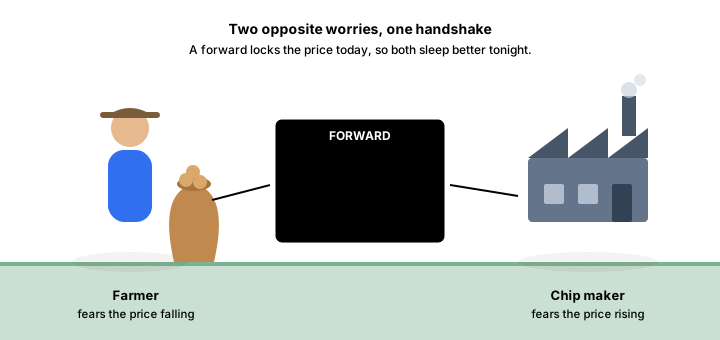
Stay with the potatoes, because the whole of futures grows out of this one handshake. A farmer is about to plant a crop he will harvest in three months. His fear is that by harvest the market will be flooded and the price will fall, wiping out his margin. Across town, the potato-chip maker from the last chapter has the opposite fear: that a poor crop will send prices up and ruin its costs. Two people, two opposite worries about the same future price.
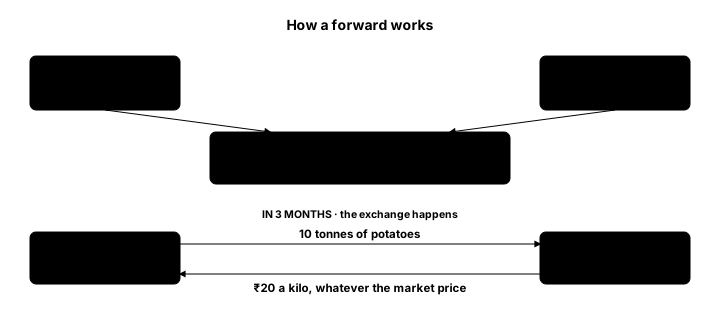
So they meet and make a deal. In three months, the chip maker will buy ten tonnes of potatoes from the farmer at 20 rupees a kilo, agreed and fixed today. No money changes hands now. The price is simply locked. That night both sleep better. The farmer knows exactly what he will earn, and the chip maker knows exactly what it will pay. That handshake is a forward, and it is the oldest derivative there is.
The idea, named
A forward is a private agreement between two parties to buy and sell a fixed quantity of an underlying, at a fixed price, on a fixed future date. The fixed price is called the forward price, here 20 rupees a kilo. Nothing is exchanged when the deal is struck; the whole transaction happens on the future date. One side agrees to buy, the other to sell, and both are bound to go through with it.
Notice that both parties are using it to hedge, exactly the insurance use from the last chapter. The farmer removes the risk of a falling price, the chip maker removes the risk of a rising one. Each gives up the chance of a happy surprise in exchange for certainty. That trade, giving up the good surprise to be rid of the bad one, is the essence of a hedge.
The payoff is a straight line
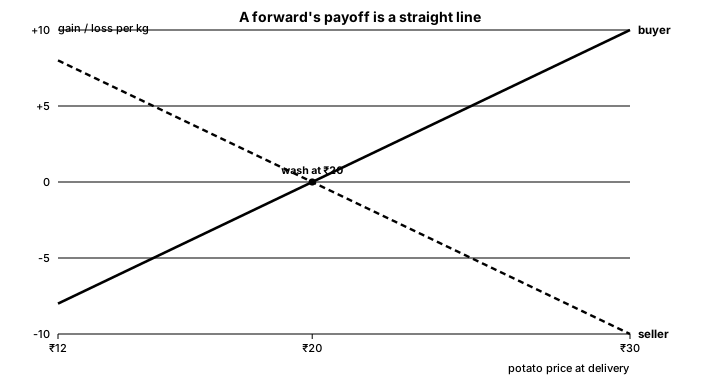
Play out the harvest and you can see the value of the forward at delivery, across every possible potato price. Take it from the chip maker's side, the buyer who has locked 20.
If potatoes end at 25, the chip maker buys at 20 what everyone else pays 25 for, a gain of 5 rupees a kilo. If they end at 30, the gain is 10. If they end at exactly 20, the deal is a wash. If they end at 15, the chip maker is obligated to pay 20 for something worth 15, a loss of 5. The higher the price, the more the buyer gains; the lower the price, the more the buyer loses, one rupee for every rupee, in a straight line with no bend in it.
The farmer, the seller, has the mirror image. He gains when the price falls below 20 and loses when it rises above, in an equal and opposite straight line. Whatever one side makes, the other loses, exactly. A forward is a zero-sum deal between two parties, and its payoff is the simplest shape in all of derivatives: a straight, unbroken line, sloping up for the buyer and down for the seller. Hold that shape in mind, because a future's payoff, which you meet in Part 2, is the very same line.
The three problems that doomed the private forward
The handshake is elegant, but as a private deal between two people it has three flaws, and every one of them is fatal for a market of strangers. The entire futures system, in the next chapter, is the fix for these three.
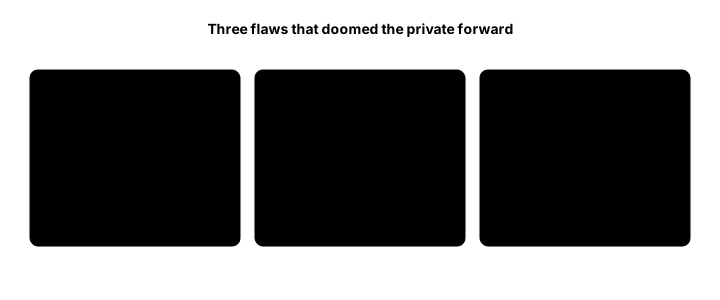
The first is counterparty risk, the danger that the other side simply does not honour the deal. Suppose potatoes crash to 12. The chip maker is now bound to pay 20 for something worth 12, and it may be tempted to walk away and buy cheaply in the market instead, leaving the farmer with nothing. Or if prices soar to 35, the farmer may renege and sell to someone else. A private forward is only as good as the honesty and the solvency of the person on the other side, and you often do not know either.
The second is that the terms are non-standard. This particular contract is for ten tonnes, of a certain grade, on a certain date. If you wanted eleven tonnes, or a different date, you would need a different counterparty and a fresh negotiation. Because every forward is bespoke, there is no crowd of ready buyers and sellers, and no clear market price to compare against.
The third is that there is no easy exit. Say the chip maker's plans change a month in and it no longer needs the potatoes. It cannot simply sell the contract to someone else, because the deal is tied to the farmer and to those exact terms. It is stuck until delivery, unless it can persuade the farmer to tear the agreement up. A forward is a room you can enter but not easily leave.
Private forwards do still exist, mostly between banks and businesses hedging currencies, where the parties are large and known to each other. But for anyone else, the three flaws are dealbreakers, and they cried out for a solution.
What to carry forward
A forward is a private, binding agreement to trade an underlying at a fixed price on a future date, and its payoff is the plain straight line you will see again in every future. It is a genuine hedging tool, but as a private deal it carries three flaws: the other side might default, the terms are bespoke and hard to match, and you cannot easily exit before the date. The next chapter introduces the invention that keeps the useful straight-line deal while removing all three flaws at once, by putting an exchange and a guarantor in the middle. That invention is the future.