Course contents
The deposit the exchange demands
To hold a future you post an initial margin, made of SPAN margin, a risk-based core, plus an exposure margin, an added buffer. It is not a cost you pay, it is a deposit against a bad day.
- Define SPAN margin and exposure margin
- Explain why margin is charged and that it is collected upfront in India
- Distinguish a margin, which is blocked and returned, from a premium, which is paid and gone
In the last chapter you held a fifteen-and-a-half-lakh position for a deposit of about one lakh fifty-six thousand. This chapter is about that deposit: what it is made of, why the exchange insists on it, and one distinction that trips up almost every beginner, which is that this money is not a cost you have spent. It is a deposit you have parked, and you get it back.
Why the deposit exists at all
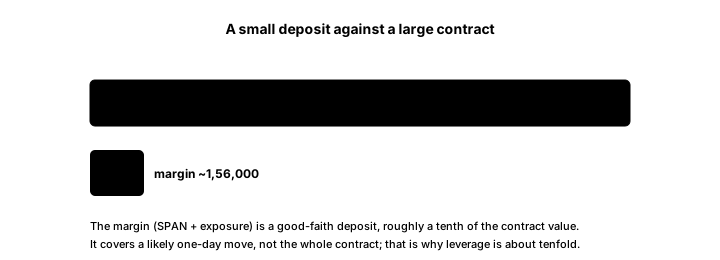
Cast your mind back to Chapter 3. When you trade a future, the clearing corporation steps into the middle and guarantees the deal, so that no trader depends on another's honesty. That guarantee is not magic; it is funded. The clearing corporation protects itself by making both sides put up money in advance, enough to cover a bad move, so that if a trader's position goes against them there is already cash on hand to settle it. That advance deposit is the initial margin. It is the price of the guarantee that makes futures safe to trade at all.
SPAN and exposure
The initial margin comes in two parts, and you will see both named on your trading screen.
The larger part is the SPAN margin. SPAN is a risk system that imagines a whole range of nasty things the market might do in a single day, a sharp fall, a sharp rise, a jump in volatility, and calculates how much money would be needed to cover the worst plausible one-day move in your position. It then charges you that amount. Because it is tied to the risk of the specific contract, SPAN margin rises when the market turns volatile and falls when things are calm.
The smaller part is the exposure margin, an additional flat buffer stacked on top of SPAN, a second cushion in case the real move is worse than SPAN assumed. Add the two together and you have the initial margin, the full deposit you must have before you can hold the position. For one lot of NIFTY futures that total is around one lakh fifty-six thousand rupees, roughly a tenth of the contract value, though the exact figure moves with volatility and with the rules of the day. (Illustrative; confirm current margins.)
In India this margin is now collected upfront. You must have the full amount in your account before the trade, not scrambled together afterwards. The days of taking a large position on a sliver of margin and topping up later are gone, by regulation, and this is a protection, not an inconvenience.
A deposit, not a cost
Here is the distinction that matters most, and it is where options and futures part company. When you buy an option, you pay a premium. That money leaves your account and is gone; it is the price of the option, and the most a buyer can lose. When you hold a future, you pay no premium at all. The margin is not a payment to anyone. It is your own money, blocked and set aside as a deposit, and when you close the position it is released back to you, adjusted for whatever you made or lost on the trade.
So a future does not cost you anything to put on, in the way an option does. It only ties up capital. This sounds like an advantage, and in one narrow sense it is, there is no premium to earn back. But do not let it comfort you. The reason there is no premium is that there is no floor under your loss, the missing floor from the payoff chapter. The option buyer's premium bought them a capped downside. The futures trader kept the premium and kept the uncapped risk. The margin is not the price of the trade; it is merely the deposit that lets you carry a risk that has no natural limit.
What the margin is not
One honest caution about what the deposit does and does not promise. The margin is the exchange's estimate of a bad single day, calculated to cover the worst plausible move over roughly one session. It is not the maximum you can lose. If the market gaps far beyond what SPAN imagined, over a weekend or on shock news, your loss can exceed the margin you posted, and you will owe the difference. The margin protects the clearing corporation's guarantee; it does not put a ceiling on your personal loss. The next two chapters, on daily settlement and the margin call, show exactly how a loss reaches in and takes that deposit, and sometimes more.
What to carry forward
The deposit you post to hold a future is the initial margin, made of SPAN margin, a risk-based core that grows with volatility, and exposure margin, an added buffer, collected upfront by rule in India. Unlike an option premium, it is not a cost; it is your own capital blocked and then returned when you close, adjusted for your profit or loss, because a future charges no premium. But that also means there is no premium-bought floor under your loss, and the margin is only an estimate of a bad day, never the most you can lose. The next chapter shows how your profit and loss are actually settled while the position is open, not at expiry but every single evening, through mark-to-market.