Course contents
Carrying a position to the next month
To keep a futures view past expiry you roll, closing the expiring contract and opening the next month's. Rolling is a routine move, and the amount of rolling the whole market does is itself a signal.
- Explain what rolling a futures position means and why it is a fresh contract, not an extension
- Work the cost of a roll from the basis
- Read market-wide rollover activity as a clue to sentiment
Your near-month NIFTY future is a day from expiry, but the move you expected has not finished playing out and you want to stay in the trade. The contract cannot be extended; it is going to expire whether you like it or not. So instead you roll: you close the expiring contract and open the same position in the next month, carrying your view forward into a fresh contract. Rolling is one of the most routine things a futures trader does, and understanding its small cost and its crowd-level signal rounds out how a future behaves over time.
What rolling is
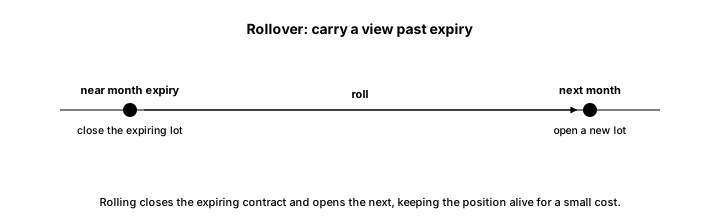
Rolling a position means closing your position in the expiring contract and simultaneously opening an identical position in a later-expiry contract. It is two trades, not a magical extension of one. If you are long one lot of the near-month NIFTY future, you sell that near-month lot to close it and buy one lot of the next-month future to reopen the position. Your directional exposure to NIFTY is unbroken; only the contract carrying it has changed.
You roll for the obvious reason: your view needs more time than the expiring contract has left. You may also roll a single-stock future specifically to avoid the physical delivery from the last chapter, closing the near contract before it can settle and moving the position to the next month.
The cost of a roll
Rolling is not free, and the cost comes straight from the basis you just learned. Because the next-month future carries more cost of carry, it trades higher than the near-month one. Suppose the near-month NIFTY future is at 24,115 and the next month is at 24,230. To roll a long, you sell the near at 24,115 and buy the next at 24,230, so you are buying back in about 115 points higher than you sold. That 115-point difference, about 7,500 rupees on a lot of 65, is the cost of the roll, and it is essentially one more month of carry. (All figures illustrative.)
This matters because it is a recurring cost. Every time you roll a long position to the next month, you pay roughly another month's carry. Holding a leveraged futures view over many months is therefore not free even ignoring the market's moves; the carry quietly bleeds a little at each roll. For a short position the sign flips, and the roll can work slightly in your favour, since you sell the higher far-month and buy back the lower near-month. Either way, the roll cost is the basis difference between the two months, and you should know it before you assume you can simply hold a future indefinitely.
Rollover as a signal
Beyond your own trade, the market as a whole rolls around each expiry, and how much it rolls is watched as a clue to sentiment. Near expiry, analysts track the rollover percentage, the share of open positions that moved from the expiring contract into the next one rather than simply closing. A high rollover suggests traders are carrying their positions forward with conviction, keeping their bets alive into the new month. A low rollover suggests positions are being closed rather than continued, a sign of less conviction or of a view that has run its course. Whether it is mostly longs or mostly shorts doing the rolling adds colour to the read.
Treat this, like open interest and the basis, as a soft clue and not a precise instruction. Rollover data describes what the crowd did, not what the market will do next, and plenty of high-rollover months have still turned. It is context, not a signal to trade on by itself.
Traders usually roll during the last few days before expiry, the informal rollover window, rather than waiting for the final minutes, because liquidity is better and the pricing is cleaner when the whole market is doing the same thing over several sessions rather than in a last-moment rush.
The honest limit of rolling
One caution to carry out of this chapter. Rolling is a tool for extending a view you still hold with good reason, not a device for refusing to close a trade that is not working. A trader who keeps rolling a losing position, month after month, is paying carry at each roll and keeping a leveraged, mark-to-market risk alive the whole time, all to avoid admitting the trade was wrong. That is how a small, manageable loss is nursed into a large one. Roll to give a sound view more time; do not roll simply to postpone a decision.
What to carry forward
Rolling keeps a futures view alive past expiry by closing the expiring contract and opening the next month's, at a cost equal to the basis difference between them, which for a long is roughly another month of carry paid at every roll. It is also how traders avoid the physical delivery of a stock future. Across the market, the rollover percentage is a soft clue to how much conviction is being carried forward, to be read as context and never as a standalone signal. And rolling has an honest limit: it should extend a sound view, not postpone closing a poor one. That completes the pricing and expiry mechanics. Part 5 turns to putting futures to real work, starting with reading the crowd through open interest.