Course contents
The honest purpose of futures
The original reason futures exist is to hedge, to protect something you hold against a fall by taking an offsetting short. This chapter shows how, including hedging a whole portfolio with index futures.
- Hedge a single stock holding by shorting its future, with a worked example
- Explain beta and use it to hedge a portfolio with index futures
- Explain that a hedge trades away upside to remove downside, and is insurance, not a profit centre
Almost everything in this course so far has warned you about futures: the leverage, the margin calls, the unlimited risk. This chapter is the exception, and it is the reason futures were invented in the first place. Used to hedge, a future does the opposite of what it does in a speculative trade. Instead of amplifying your risk, it removes some of it. If you own shares and fear a fall, a futures short can act as insurance, gaining exactly what your holding loses. This is the honest, original purpose of the instrument, and the one place a beginner's risk goes down rather than up.
The idea of a hedge
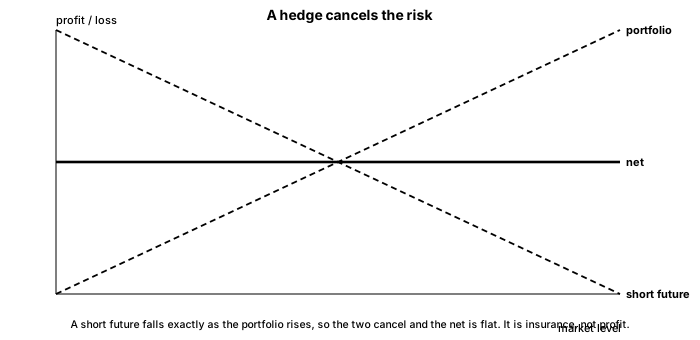
A hedge is a position taken to offset the risk of something you already hold. You own an asset that would lose value if the market fell. You take a futures short that would gain value in that same fall. Put together, the loss on the holding and the gain on the short cancel, and your combined value barely moves. You have insured yourself against the fall.
The catch, and it is a fair one, is that the insurance works both ways. If the market rises instead, your holding gains but your short loses, and again they cancel. A hedge does not let you keep the upside while removing the downside. It removes both, freezing your value for the life of the hedge. That is the price of the protection, and it is why hedging is insurance, not a way to make money.
Hedging a single stock
Start with the simplest case. Suppose you own 500 shares of Reliance, bought and held for the long term, worth about seven lakh rupees at 1,400 a share. A big event is coming and you fear a short-term drop, but you do not want to sell, perhaps for tax reasons or long-term conviction. So you hedge: you short one lot of Reliance futures, which happens to be 500 shares, matching your holding. (All figures illustrative.)
Now play it out. If Reliance falls 5%, your 500 shares lose 70 rupees each, a loss of 35,000 rupees. But your short future gains the same 70 rupees a share, 35,000 rupees, and the two cancel: your net change is zero. You rode out the fall untouched. And if Reliance rises 5% instead, your shares gain 35,000 while the short loses 35,000, again netting to zero. You gave up the gain to be safe from the loss. For the period of the hedge, your Reliance position is effectively frozen, protected from the event you feared.
Hedging a portfolio with index futures
Single stocks are the easy case. More often you hold a spread of stocks, a portfolio, and you cannot short a future on each one. Here index futures do the job, but they need a small adjustment, because your portfolio does not move exactly in step with the index.
That step is measured by beta. Beta is how much your portfolio tends to move for a 1% move in the index. A beta of 1 means it moves with the index. A beta of 1.2 means it moves 1.2% when the index moves 1%, so it is more volatile than the market. A beta of 0.8 means it moves less. To hedge a portfolio, you short not its plain value in index futures, but its value scaled by beta, because that is how much index exposure it really behaves like.
Work it. Say you hold a diversified portfolio worth eighteen lakh rupees with a beta of 1.2. To hedge it, you short index futures worth beta times the portfolio, which is 1.2 times eighteen lakh, or twenty-one lakh sixty thousand rupees of NIFTY futures, roughly one and a third NIFTY lots at our fifteen-lakh-sixty contract value. Now suppose NIFTY falls 5%. Your portfolio, at a beta of 1.2, falls about 6%, a loss of one lakh eight thousand rupees. Your short of twenty-one lakh sixty thousand in NIFTY futures gains 5%, which is also one lakh eight thousand. The two cancel. The beta scaling is what made the hedge fit.
When and why to hedge, honestly
A hedge is worth its cost only when you have a specific reason to want it. The usual reasons are a known event you want to sit through without selling, a holding you cannot or do not wish to sell but want to protect for a while, or simply a stretch of market nervousness where you would rather freeze your value than ride it out. Outside such reasons, a permanent hedge is just a way of holding cash expensively, since it cancels your upside too.
And a hedge is not free. You give up the upside for its duration, you pay the transaction costs on the futures, and you carry the small cost embedded in the basis. A partial hedge, shorting fewer lots than a full offset, is a common middle path: it softens a fall without giving up all the upside, letting you dial your exposure down rather than off. However you use it, the honest framing holds: hedging is the one use of futures that reduces a beginner's risk, precisely because it is set against something you already own, not a leveraged bet on its own.
What to carry forward
Hedging is the original purpose of futures and the one that lowers rather than raises your risk. You offset a holding you own with a futures short, so a fall in the holding is matched by a gain in the short, at the price of giving up the upside too. For a single stock you short its future in the size you hold; for a portfolio you short index futures scaled by beta, the portfolio's sensitivity to the index. It is insurance for a specific, temporary reason, not a profit centre, and it is not free. The next chapter shows another lower-risk use of futures, the calendar spread, which trades the gap between two months rather than the market's direction.