Course contents
Why the future costs a bit more than spot
A future's fair price is the spot price plus the cost of carry, the interest to fund the position minus the dividends you give up. This is why an index future usually trades a little above spot.
- Explain the cost-of-carry idea in plain words
- Work a NIFTY fair-value example with real-shaped figures
- Explain why the future and the spot price converge as expiry nears
Look at your screen on a calm day. NIFTY, the index itself, sits at 24,000. The near-month NIFTY future sits a little higher, at around 24,115. The gap is small but it is always there, and a new trader's first instinct is to read it as a forecast, as if the market were quietly predicting that NIFTY will rise 115 points. That reading is wrong, and correcting it teaches you how futures are priced. The 115 points is not a prediction. It is arithmetic, and its name is the cost of carry.
Two ways to hold the index
Imagine you want exposure to NIFTY for one month. You have two ways to get it.
The first is to buy the basket of stocks in the cash market today. To do that you need the full money now, say by borrowing it, on which you would pay interest for the month. But while you hold the stocks, some of them pay dividends, which you would collect. So the real cost of holding the cash position for a month is the interest you pay to fund it, minus the dividends you receive.
The second way is to buy the future. You put up only margin, not the full value, and you get the same exposure to NIFTY's moves for the month.
For the market to be fair, these two routes must cost the same. If the future were priced the same as spot, everyone would take the second route and skip the funding cost, which cannot be right. So the future must be priced higher than spot by exactly the net cost of carrying the cash position: the funding interest, less the dividends. That extra is the cost of carry.
The fair price, in a formula
Put it in one line. The fair price of a future is the spot price plus the cost of carry:
Fair futures price = Spot x (1 + (r - d) x T)
Here r is the risk-free interest rate, the cost of funding the position; d is the dividend yield of the underlying, the income you give up by holding the future instead of the stocks; and T is the time to expiry, as a fraction of a year. The term (r - d) is the net carry rate, and multiplying by T scales it to how long you are holding.
Work it for our NIFTY future. Take the spot at 24,000, a risk-free rate of about 7%, a NIFTY dividend yield of about 1.2%, and one month to expiry, so T is 30 divided by 365. The carry is 24,000 times (0.07 minus 0.012) times (30 over 365), which comes to about 114 points. Add that to 24,000 and the fair future is about 24,114, almost exactly the 24,115 on the screen. (All figures illustrative; confirm current rates.) The gap was never a forecast. It was 7% funding minus 1.2% dividends, for one month, on 24,000.
Why it is usually a premium, and sometimes not
For an index in India, the funding rate r is normally higher than the dividend yield d, so the net carry (r - d) is positive, and the future trades above spot. This is the usual picture: a small, steady premium that is larger for far-month contracts, because they have more time, more T, and so more carry.
It is not a law, though. If the underlying is about to pay a large dividend, the dividend yield for that short period can outweigh the funding cost, making (r - d) negative and pushing the future below spot. This is common in single stocks around dividend dates. So the premium is not magic and not always there; it simply reflects whether funding or dividends dominate over the life of the contract.
Convergence at expiry
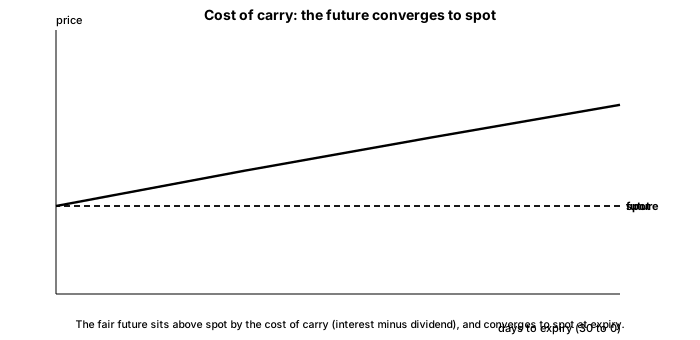
One more consequence falls straight out of the formula, and it matters for everything ahead. As expiry approaches, T shrinks toward zero, so the cost of carry shrinks too, and the future's fair price moves closer and closer to spot. On the expiry day itself, with essentially no time left, the future and the spot price are the same. This is called convergence, and it is enforced by arbitrage: if the future ever strayed far from its fair value, traders would buy the cheaper of the future and the cash position and sell the dearer, pocketing the difference, until the gap closed. The future is tethered to spot by carry, and the tether pulls tight at expiry.
What to carry forward
A future is priced at spot plus the cost of carry, which is the interest to fund an equivalent cash position minus the dividends you forgo, scaled by the time to expiry. That is why an index future usually sits a little above spot, why the premium is bigger for far months, and why a heavy dividend can flip it into a discount. As expiry nears, the carry fades and the future converges to spot, held there by arbitrage. Above all, the premium is arithmetic, not a prediction. The next chapter gives this gap its proper name, the basis, and the two words for its direction, contango and backwardation.