Course contents
Betting up, and betting down
You go long a future to profit if the price rises, and short it to profit if it falls. A future lets you sell first and buy back later as easily as the other way round, which owning shares does not.
- Explain long and short futures positions and their profit and loss
- Show that shorting a future is as ordinary as buying one
- Contrast this with the difficulty and limits of shorting delivery shares
A future is a two-way street, and this is one of its real attractions. Two traders can look at NIFTY sitting at 24,000, one convinced it will climb and the other sure it will slide, and both can act with the same instrument, just as easily, just as directly. The one who expects a rise goes long. The one who expects a fall goes short. Neither has an easier path than the other, and that even-handedness is something the ordinary share market does not offer.
Going long
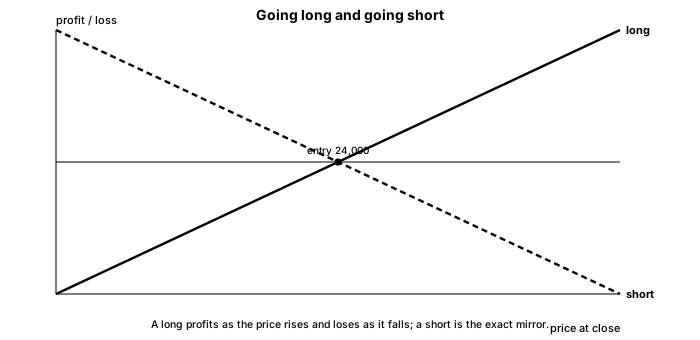
To go long a future is to buy it, betting the price will rise. Buy one lot of NIFTY futures at 24,000, with a lot of 65, and your profit or loss moves one for one with the index from there. (All figures illustrative.)
If NIFTY climbs to 24,200, you are ahead by 200 points, and at 65 to the point that is 13,000 rupees. If it climbs to 24,400, you are ahead 26,000. If instead it slips to 23,800, you are down 200 points, or 13,000 rupees. There is no premium to pay as there is with a bought option, and no strike to clear. You simply gain rupee for rupee as NIFTY rises above your entry and lose rupee for rupee as it falls below.
Going short
To go short a future is to sell it without owning it first, betting the price will fall. This is the move that surprises newcomers, because it feels backwards to sell something you do not have. On the exchange it is ordinary. You place a sell order for one lot, and now you profit if the price drops and lose if it rises, the exact mirror of the long.
Short one lot of NIFTY futures at 24,000. If NIFTY falls to 23,800, you are ahead 200 points, 13,000 rupees, because you can now buy back at 23,800 what you sold at 24,000. If it falls to 23,600, you are ahead 26,000. But if NIFTY rises to 24,200, you are down 13,000, because you must buy back higher than you sold. The short gains from a fall and suffers from a rise.
Watch the two positions side by side, both entered at 24,000 on one lot of 65.
| NIFTY at close | Long one lot (P&L) | Short one lot (P&L) |
|---|---|---|
| 23,700 (falls 300) | minus 22,500 | plus 22,500 |
| 24,000 (flat) | 0 | 0 |
| 24,300 (rises 300) | plus 22,500 | minus 22,500 |
Whatever the long makes, the short loses, and the reverse. A future is a zero-sum deal, the same straight-line mirror you first saw in the forward.
Why easy shorting matters
The ease of going short is not a small convenience, it is one of the main reasons futures exist and one of the main reasons traders use them. In the cash share market, selling shares you do not own is hard. A retail trader can usually only short intraday, squaring off the same day, and cannot simply hold a short position in a stock overnight without an involved stock-lending arrangement. The system is built around owning and holding, not around betting on a fall.
Futures remove that asymmetry entirely. Going short is a first-class action, no harder than going long, needing no borrowing and no special permission, and it can be held for as long as the contract runs. This is what lets a trader profit from a falling market, and, more importantly as Chapter 16 will show, what lets an investor protect a holding by taking an offsetting short. The two-way street is the point.
The risk is symmetric, and open on both sides
Because the two positions mirror each other, so does their danger. A long future loses as the price falls, all the way down toward zero. A short future loses as the price rises, and a price has no ceiling, so a short's loss is open-ended in the way you met with the naked short call in the options course. Neither side has a floor under its losses. The ease of shorting can lull a beginner into treating it lightly, but a leveraged short caught in a sharp rally can hurt just as fast as any position in this course, and there is no natural point at which it stops.
What to carry forward
A future runs both ways. Go long to profit from a rise, go short to profit from a fall, and the two are precise mirrors, one gaining exactly what the other loses. Unlike the share market, a future lets you short as naturally as you buy, without borrowing or an overnight limit, which is what makes futures the tool for bearish views and, later, for hedging. That freedom comes with symmetric, open-ended risk on both sides. The next chapter draws this out in a single picture, the straight-line payoff, and sets it against the bent payoff of an option so you can see exactly what a future gives you and what it takes away.