Course contents
Reading a futures contract
Every futures contract is set by four things, its underlying, its lot size, its contract value, and its expiry. Learn to read one, using NIFTY and a single stock, with India's current contract sizes.
- Define lot size, contract (notional) value, and expiry
- Read an Indian futures symbol
- State the current index-derivative contract-value framework and that it changed in 2024
Pull up a NIFTY futures quote and you see a short name, a price that ticks, and a date. Behind those few characters sit four decisions the exchange has already made for you, and once you can read all four, a futures contract stops being a code and becomes a clear statement of exactly what you are trading and how much of it. This chapter reads that statement, using NIFTY and a single stock, and it uses India's current contract sizes, which changed in a way worth knowing.
The four things that define a contract
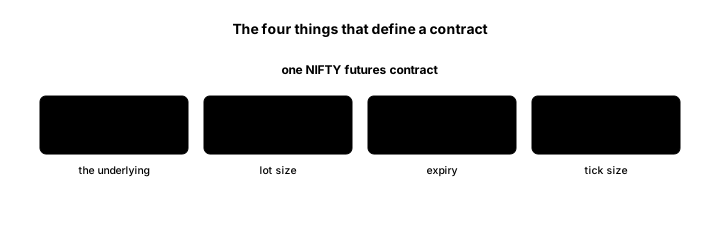
Every futures contract is fixed by four features: its underlying, its lot size, its contract value, and its expiry.
The underlying is what the future tracks, the asset whose price it borrows, in the language of Chapter 1. For a NIFTY future the underlying is the NIFTY index. For a Reliance future it is one Reliance share. The future rises and falls with its underlying and nothing else.
The lot size is the fixed bundle a future trades in. You cannot buy a future on a single index point or a single share. You buy one lot, and the lot is a set number of units. For NIFTY the lot is a fixed number of index units, which we will take as 65 in this course. (Lot sizes are set by the exchange and change from time to time, so this figure is illustrative; confirm the current NIFTY lot size.) A Reliance future might come in a lot of, say, 500 shares. You trade in whole lots: one lot, two lots, but never a third of a lot.
The contract value, also called the notional value, is the real economic size of what you control, and it is simply the lot size times the price. One lot of NIFTY futures at 24,000, with a lot of 65, is 24,000 times 65, which is 15,60,000 rupees, fifteen lakh sixty thousand. That is the size of the position you are holding, even though, as Chapter 7 will show, you will put up only a small fraction of it to hold it. One lot of Reliance futures at 1,400 rupees, with a lot of 500, is a contract value of 7,00,000 rupees. (All figures illustrative.)
The expiry is the date the contract ends. Indian equity futures expire monthly. At any moment three monthly contracts trade side by side: the near month, the next month, and the far month, and most activity sits in the near one. The expiry has conventionally fallen on the last Thursday of the month, though the exact expiry day has been revised recently, so treat the day as something to confirm rather than assume..
Reading the symbol
Put those together and an Indian futures symbol reads plainly: the underlying, the expiry month, and the letters FUT for future. A near-month NIFTY future is written as the index name, its expiry month, and FUT. There is no strike price and no CE or PE, because a future is not an option: there is no strike to choose and no right to price, only the underlying, the size, and the date. If you learned to read an option symbol in Options Basics, notice what is missing here, and that absence is the whole difference between the two instruments.
One last small feature you will see is the tick size, the smallest amount the price can move, often five paise for these contracts. It matters only in that prices step in ticks rather than flowing continuously, and it is rarely something a beginner needs to think hard about.
The contract value is the real size, and it grew
Here is the number to respect: the contract value, not the price, is the size of your bet. When you hold one lot of NIFTY futures, you are exposed to fifteen lakh sixty thousand rupees of index, and a one percent move in NIFTY is roughly fifteen thousand six hundred rupees to your account, up or down. The price on the screen, 24,000, hides that scale until you multiply by the lot.
This is also why a recent rule matters. From late 2024, the Indian regulator raised the size of index derivative contracts, lifting the target contract value from an earlier five to ten lakh rupees up to roughly fifteen to twenty lakh. The exchanges did this by increasing lot sizes. The reason was deliberate: a larger minimum contract keeps the smallest, most thinly funded accounts out of positions whose leverage they cannot survive, which is a risk measure aimed squarely at protecting beginners from themselves..
What to carry forward
Four features define any futures contract: the underlying it tracks, the lot size it trades in, the contract value that is the real size of your position, and the monthly expiry on which it ends. The symbol names the underlying, the month, and FUT, with no strike, which is exactly what marks a future apart from an option. Above all, read the contract value and let it, not the price on the screen, tell you how large your bet really is, because in late 2024 India deliberately made that minimum larger to protect small accounts. The next chapter puts the contract to work in its two directions, going long to profit from a rise and going short to profit from a fall.