Course contents
How futures traders blow up
The leverage that magnifies a gain magnifies a loss just as fast, and daily settlement turns that loss into real cash the same evening. Overnight gaps and margin calls are how leveraged accounts get wiped out.
- Explain how leverage together with daily mark-to-market can drain an account far faster than owning shares
- Explain overnight-gap risk, since a future cannot be stopped out while the market is closed
- State plainly that you can lose more than the margin you put up
The course opened by promising to keep the danger of futures in plain view, and this chapter is where that promise comes due. Everything from Part 3, leverage, margin, daily settlement, the margin call, comes together here into a single picture: how an account actually gets wiped out. It does not happen through some exotic disaster. It happens through an ordinary market move meeting an over-sized position, and it happens fast. Understanding the mechanism is the best protection against being its next example.
The blow-up, step by step
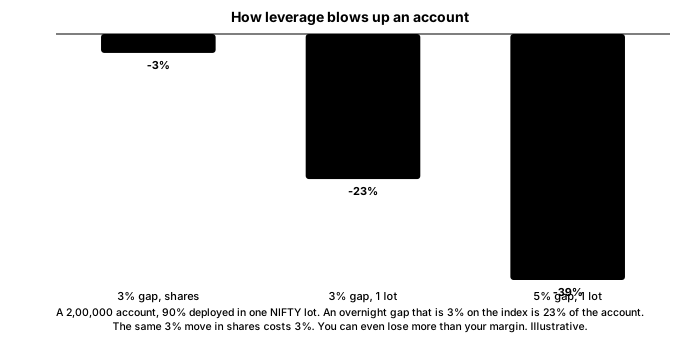
Picture a trader with two lakh rupees, who takes one lot of NIFTY futures. The margin is about one lakh fifty-six thousand, so seventy-eight percent of their capital is committed and they are running close to full leverage, with a thin buffer. Nothing about this feels reckless; the position looked affordable, because the margin was affordable. But watch what an ordinary bad night does. (All figures illustrative.)
Suppose news breaks overnight and NIFTY opens 3% lower, a gap of 720 points, which is a large but entirely normal event over a year. Mark-to-market debits 720 times 65, which is 46,800 rupees, that morning. In a single move the trader has lost 23% of their entire capital, and their balance, now one lakh fifty-three thousand, has fallen below the required margin. The margin call arrives. If they cannot add funds at once, the position is squared off, crystallising the loss near the low. Had the gap been 5%, the loss would have been 78,000 rupees, 39% of everything, in one morning.
Compare that with the same two lakh held as shares or an index fund. A 3% fall there costs 6,000 rupees, 3% of the capital, and no one calls you, and you can simply wait. The market did exactly the same thing in both cases. Leverage turned a 3% event into a 23% event, and daily settlement made it real cash before the trader had finished their coffee. That, in one example, is how futures accounts die.
Why it is worse than a losing share
Two features make this sharper than any loss in the cash market.
The first is daily settlement. A losing share is a paper loss you can choose to ignore while you wait for a recovery. A losing future is not: the loss is debited in cash that same evening, and if it takes your balance below the margin, you are forced out before any recovery can arrive. The market does not wait for your thesis to come good, and neither does the mark-to-market.
The second is the gap. A future cannot be closed or stopped while the market is shut, so an overnight or weekend move lands in full when trading reopens. This is why a stop-loss, useful as it is during the day, does not save you from a gap: your stop simply fills at the gapped-open price, not at the level you set. Global cues, a surprise result, a geopolitical shock, any of these can move NIFTY several percent before you can lift a finger, and the whole move is debited at once.
You can lose more than you put in
Here is the hardest truth, and the one that most separates a leveraged future from a bought option or a share. Your margin is not a limit on your loss. If a gap is large enough, the mark-to-market debit can exceed your entire balance, and your account goes negative: you now owe the broker money, having lost more than you ever deposited. A share can fall to zero and no further; a bought option can only lose its premium; a leveraged future can leave you in debt. The margin was the exchange's estimate of a normal bad day, and a gap is not a normal day.
The mechanism is the message
Notice what was, and was not, the cause of the blow-up. It was not a wild, unforeseeable crash. It was a routine 3% move, the kind that happens several times a year, meeting a position sized to leave no room for it. The trader did not misread the market so much as mis-size the trade. Almost every futures wipeout is, at heart, a position-size mistake, and the ordinary move that triggers it was always going to come eventually. This is why the guardrails from Part 3, a generous cash buffer and a deliberately small position, are not cautious extras. They are the difference between surviving the routine bad night and being ended by it.
What to carry forward
An account is destroyed not by a freak event but by an ordinary move landing on an over-sized, fully-leveraged position: the loss is magnified by leverage, taken in cash the same day by mark-to-market, forced out at the bottom by the margin call, and, if a gap is large enough, driven past the margin into a debt you owe. A future can lose you more than you put in, which a share or a bought option cannot. The cause is almost always size, not a wrong view, which is why small positions and a real buffer are survival, not caution. The next chapter turns this into a concrete list of the common mistakes and their guardrails, and the final chapter into a checklist and the practice sandbox.