Course contents
Controlling a lot with a little
A future lets you control a large contract value while putting up only a small margin. That leverage magnifies both gains and losses, and it is the single biggest reason beginners lose money in futures.
- Define leverage as the ratio of contract value to margin
- Work how a small percentage move in the underlying becomes a large percentage gain or loss on your margin
- State honestly why leverage, not direction, is the main danger
Here is the fact that gives a future both its appeal and its danger in the same breath. To hold one lot of NIFTY futures worth fifteen lakh sixty thousand rupees, you do not need fifteen lakh sixty thousand. You need to deposit only a small fraction of it, around one lakh fifty-six thousand, and the position is yours. That small deposit controlling a large position is called leverage, and it is the most important thing in this whole course to understand, because it is the reason a simple, straight-line instrument empties so many accounts.
What leverage is
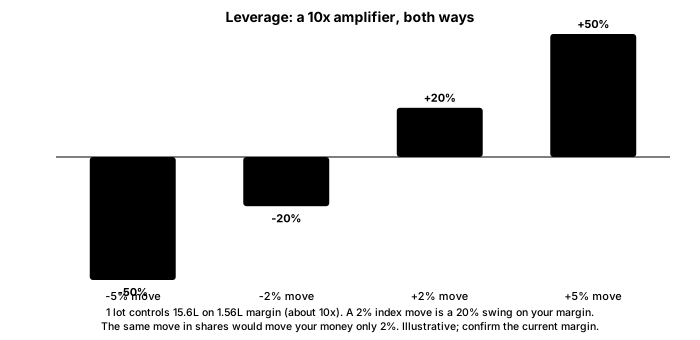
Leverage is the ratio between the size of the position you control and the money you put up to control it. One lot of NIFTY futures at 24,000, with a lot of 65, is a contract value of fifteen lakh sixty thousand rupees. The deposit to hold it, which the next chapter explains, is about one lakh fifty-six thousand. Divide the one by the other and you get a leverage of ten times. Your money is doing the work of ten times itself. (All figures illustrative; confirm the current margin.)
Leverage sounds like an advantage, and in a winning trade it is. But read it carefully, because it does not do what beginners hope. Leverage does not improve your odds of being right. It does not make the market move more. All it does is multiply the rupee result of the move, good or bad, against the small sum you put up. It is a magnifying glass held over an outcome you do not control.
The magnifying glass, in numbers
Watch what a modest move in NIFTY does to your fifteen-and-a-half-lakh position, measured against the one lakh fifty-six thousand you actually posted.
| NIFTY move | Profit or loss on one lot | As a share of your margin |
|---|---|---|
| minus 5% | minus 78,000 | minus 50% |
| minus 2% | minus 31,200 | minus 20% |
| flat | 0 | 0 |
| plus 2% | plus 31,200 | plus 20% |
| plus 5% | plus 78,000 | plus 50% |
Look at what a 2% move does. A 2% rise in NIFTY, an ordinary day, hands you 31,200 rupees, which is 20% of your deposit. Wonderful. But a 2% fall takes exactly the same 20% away. And a 5% move, which happens often enough over a few sessions, swings half your capital, in whichever direction the market chose. The instrument did nothing clever. It simply took a normal 2% wobble in the index and turned it into a 20% event in your account.
Compare this with owning shares outright. If you had bought one lakh fifty-six thousand rupees of shares in the cash market, a 2% fall would cost you 3,120 rupees, which is 2% of your money, no more. The same 2% move in the leveraged future costs you 31,200, ten times as much, because you were controlling ten times the value. Same market, same move, ten times the pain and ten times the gain.
Why this is the main danger
Every warning in this course traces back to this one page. Options can lose you a premium; a naked option seller can be badly hurt; but the plainest, most common way a beginner loses money in derivatives is by taking a leveraged futures position too large for their account and being caught by an ordinary move. The trap is that the position feels affordable, because the margin is small, while the risk is the size of the full contract, which is large. The margin is what you put up. The contract value is what you are exposed to. Beginners size their trades by the first and are destroyed by the second.
And leverage cuts down faster than it builds up, for a human reason as much as a mathematical one. A 20% loss in a day frightens people into closing at the bottom, or forces them out through a margin call, before any recovery. The magnifying glass works on your nerves as well as your capital.
What to carry forward
Leverage is the ratio of the large position you control to the small margin you post, and for a NIFTY future it is around ten times. That multiplier turns a 1% move in the index into a 10% swing in your account and a 5% move into half your capital, up or down, without changing your odds of being right. It is why a simple straight-line instrument is the most common way beginners lose money, because they size by the small margin and are exposed to the large contract. The next chapter looks closely at that margin: what SPAN and exposure margin are, why the exchange demands them, and why a margin is a blocked deposit, not a cost you pay.