Course contents
How much to bet
How much to allocate to each edge is as important as the edge itself, and the mathematics of optimal sizing runs from volatility targeting to the Kelly criterion, which the Risk and Psychology course deliberately deferred to here. This chapter teaches sizing at the portfolio level and the hard lesson that full Kelly is too aggressive to survive, so professionals use a fraction of it.
- Size positions by volatility targeting and risk budgeting
- Explain the Kelly criterion and why fractional Kelly is used in practice
- Connect over-sizing and leverage to the risk-of-ruin idea from Risk and Psychology
How much of your capital to put behind an edge is as important as the edge itself, and it is where the Risk and Psychology course deliberately left a gap, promising the Kelly criterion here. Kelly answers the question precisely: the bet size that maximises long-run growth. Its answer is also a warning, because the growth-optimal bet is far more aggressive than any sane person should take.
Volatility targeting
Start with the practical method professionals actually use day to day: volatility targeting. You pick a target for your portfolio's volatility, say 10% a year, and size your positions so the portfolio's expected volatility hits that target, scaling down when markets are wild and up when they are calm. It keeps your risk roughly constant through changing conditions, which is exactly what the risk courses wanted, and it sidesteps the trap of a fixed position size that quietly becomes enormous risk when volatility spikes. Most of good sizing is this unglamorous act of holding risk steady.
The Kelly criterion
For the theoretically optimal size, there is Kelly.
# The Kelly criterion sizes a bet to maximise long-run growth. For a strategy with
# mean return m and variance v per period, the growth-optimal leverage is f* = m/v.
# But full Kelly is violently volatile, and beyond it growth REVERSES as risk of
# ruin takes over. We simulate long-run growth at fractions of Kelly.
import numpy as np

rng = np.random.default_rng(14)
m = 0.01                 # 1% expected monthly return at full investment (illustrative)
v = 0.04 ** 2            # monthly variance (4% monthly volatility)
kelly = m / v

print(f"Edge: {m * 100:.1f}% mean, {np.sqrt(v) * 100:.1f}% volatility per month")
print(f"Full-Kelly leverage f* = m / v = {kelly:.1f}x   (very aggressive)\n")

n_months, n_paths = 240, 3000
print("Fraction of Kelly -> median 20-year growth, and median worst drawdown:")
for frac in [0.25, 0.5, 1.0, 1.5, 2.0]:
    lev = frac * kelly
    finals, drawdowns = [], []
    for _ in range(n_paths):
        r = lev * rng.normal(m, np.sqrt(v), n_months)
        equity = np.cumprod(1 + r)
        finals.append(equity[-1])
        peak = np.maximum.accumulate(equity)
        drawdowns.append(((equity - peak) / peak).min())
    print(f"  {frac:.2f} Kelly ({lev:4.1f}x): median growth {np.median(finals):7.2f}x, "
          f"median worst drawdown {np.median(drawdowns) * 100:6.1f}%")

print("\nFull Kelly grows fastest in theory but its drawdowns are brutal, and beyond")
print("Kelly, growth reverses as risk of ruin takes over. Professionals size at a")
print("FRACTION of Kelly (often half or less), trading a little growth for survival.")
print("This is the risk-of-ruin lesson from Risk and Psychology, made precise.")Edge: 1.0% mean, 4.0% volatility per month Full-Kelly leverage f* = m / v = 6.2x (very aggressive) Fraction of Kelly -> median 20-year growth, and median worst drawdown: 0.25 Kelly ( 1.6x): median growth 25.48x, median worst drawdown -35.9% 0.50 Kelly ( 3.1x): median growth 255.81x, median worst drawdown -62.2% 1.00 Kelly ( 6.2x): median growth 1183.01x, median worst drawdown -92.8% 1.50 Kelly ( 9.4x): median growth 0.93x, median worst drawdown -100.0% 2.00 Kelly (12.5x): median growth -0.00x, median worst drawdown -119.0% Full Kelly grows fastest in theory but its drawdowns are brutal, and beyond Kelly, growth reverses as risk of ruin takes over. Professionals size at a FRACTION of Kelly (often half or less), trading a little growth for survival. This is the risk-of-ruin lesson from Risk and Psychology, made precise.
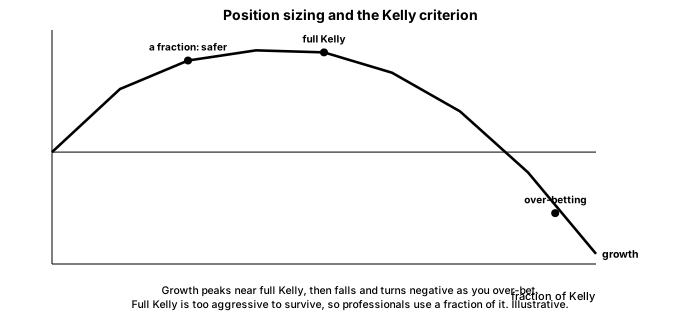
The Kelly criterion says the growth-optimal leverage is the edge's mean return divided by its variance. For the modest edge here, 1% a month at 4% volatility, that is 6.2 times leverage: enormous. The simulation shows why nobody sane bets full Kelly. Growth does rise with leverage up to full Kelly, and spectacularly, a median of over a thousand times capital across twenty years, but the drawdowns become unbearable: full Kelly's median worst drawdown is minus 93%, meaning you routinely watch almost all your money vanish before it recovers. No human survives that, and would abandon the strategy at the bottom. And look past full Kelly: at 1.5 times Kelly the twenty-year median growth reverses into a loss, and at 2 times it is total ruin. There is a peak, and beyond it more aggression means less wealth and then bankruptcy.
Fractional Kelly, and the risk of ruin
So professionals bet a fraction of Kelly, often a half or a quarter, giving up some growth for a drawdown they can actually live through. This is the risk-of-ruin lesson from Risk and Psychology made precise. There is a bet size beyond which more aggression lowers your long-run wealth and eventually ruins you, and that size is below full Kelly, not above it. Two more cautions sharpen this. Kelly needs your true edge as an input, and Part 4 showed you barely know it, so any error means you are betting a larger fraction of your real edge than you think, pushing you toward the dangerous side. And Kelly assumes you can lever, which for a retail trader means borrowing, with all the ruin the Futures and Risk courses attached to leverage. The honest response is to size well below full Kelly, treat leverage with fear, and remember that surviving is the precondition for compounding.
What to carry forward
How much to bet is as important as the edge. Volatility targeting, sizing to a steady portfolio volatility, is the everyday method. The Kelly criterion gives the growth-optimal leverage but is savage: full Kelly here means 6x leverage and a 93% drawdown, and betting beyond Kelly turns growth into ruin, so professionals bet a fraction of it. This is the risk-of-ruin lesson from Risk and Psychology made exact, sharpened by the facts that you never truly know your edge and that leverage is dangerous. Size below Kelly and survive. The final chapter of this part manages the risk of the whole book, including the value-at-risk measure that course also deferred.