Course contents
The realistic path
The genuinely useful, accessible version of everything in this course is factor investing: gaining disciplined, rules-based exposure to documented factors through the smart-beta index funds and ETFs India's exchanges already offer, rather than running a solo strategy. This chapter presents it as the sane quant path for most people, low in turnover, evidence-based, and buildable today.
- Define factor investing and smart beta and connect them to the NSE factor indices and available funds
- Contrast disciplined factor exposure with running an individual quant strategy
- Frame factor investing as the realistic application of the course for most readers
After a whole course of warnings, here is the constructive landing, and it is genuinely useful. The accessible, sensible version of everything you have learned is not running a solo quant strategy against the professionals. It is factor investing: gaining disciplined, rules-based exposure to the proven factors through low-cost funds that already exist, on India's own exchanges. For most people, this is what quant should mean.
Smart beta, concretely
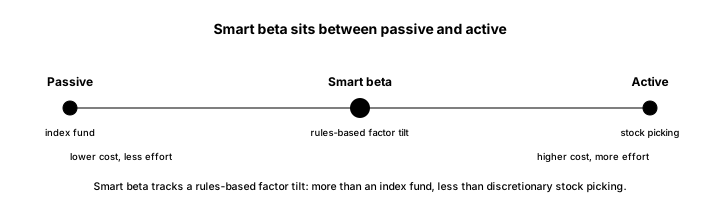
Factor investing, often sold as smart beta, is a rules-based fund that tilts toward a factor, value, quality, momentum, low volatility, or a blend, instead of simply weighting stocks by size like a plain index. It sits between passive indexing and active management: rules-based and cheap like the former, deliberately tilted toward a documented edge like the latter. Here is what such a tilt looks like.
# The realistic path: a long-only, low-turnover tilt toward proven factors, held
# like an index fund. We combine value, quality, and low-volatility scores, hold
# the top half of the market equally weighted, and compare to owning the whole
# market. This is smart beta, buyable today as an NSE factor index fund or ETF.
import pandas as pd
from factor_data import make_market, annual_sharpe, max_drawdown

returns, static = make_market()
n_stocks = returns.shape[1]


def z(series):
    return (series - series.mean()) / series.std()


stock_vol = returns.std()                                   # each stock's volatility
score = z(static["earnings_yield"]) + z(static["roe"]) - z(stock_vol)   # value + quality + low-vol
top_half = score.sort_values(ascending=False).index[:n_stocks // 2]

weights = pd.Series(0.0, index=returns.columns)
weights[top_half] = 1.0 / len(top_half)                     # equal-weight the top half
smart_beta = (returns * weights).sum(axis=1)               # low turnover: a rare rebalance
market = returns.mean(axis=1)                              # equal-weight whole market

print("Long-only multi-factor 'smart beta' versus owning the whole market:")
print(f"  smart beta: total {((1 + smart_beta).prod() - 1) * 100:5.1f}%, "
      f"Sharpe {annual_sharpe(smart_beta):.2f}, maxDD {max_drawdown(smart_beta) * 100:.1f}%")
print(f"  market:     total {((1 + market).prod() - 1) * 100:5.1f}%, "
      f"Sharpe {annual_sharpe(market):.2f}, maxDD {max_drawdown(market) * 100:.1f}%")
print("\nThis is smart beta: a disciplined, low-turnover tilt toward proven factors,")
print("held long-only, that you can buy today as an NSE factor index fund or ETF.")
print("No shorting, no leverage, no daily research. For most people, this is quant.")Long-only multi-factor 'smart beta' versus owning the whole market: smart beta: total 161.5%, Sharpe 1.58, maxDD -9.2% market: total 70.4%, Sharpe 0.94, maxDD -12.3% This is smart beta: a disciplined, low-turnover tilt toward proven factors, held long-only, that you can buy today as an NSE factor index fund or ETF. No shorting, no leverage, no daily research. For most people, this is quant.
The portfolio tilts toward value, quality, and low volatility together, holds the top half of the market equally weighted, and rebalances rarely. In this illustrative data it returned 161.5% with a Sharpe of 1.58 and a shallower drawdown, minus 9.2%, than simply owning the whole market, which returned 70.4% at a Sharpe of 0.94. No shorting, no leverage, no daily research, and low turnover. That is smart beta, and in India you can buy exactly this kind of exposure today as an NSE factor index fund or exchange-traded fund. The specific funds and their real performance are for you to confirm, and no factor is a guaranteed winner, but the approach is a real, buyable product, not a research project.
Why this is the sane path
For a retail investor, factor investing captures the durable insight of this whole course, exposure to proven, diversified factors held with discipline, while sidestepping everything that makes solo quant a losing game. It does not compete on speed. Its costs and turnover are tiny. Its capacity is effectively unlimited, because you are buying a fund, not moving the market. And it needs no research team, no expensive data, and no daily screen-watching. It will still underperform a plain index for years at a stretch, and it demands exactly the patience the earlier courses taught, since a factor that lags for three years is normal, not broken. But it is honest, accessible, evidence-based, and something you can act on this week, which is far more than the quant hedge fund fantasy offers. For most readers, disciplined factor investing is the wise and realistic application of everything in this course.
What to carry forward
The realistic version of everything in this course is factor investing, or smart beta: a rules-based, low-turnover tilt toward proven factors that in this illustration beat the whole market at a higher Sharpe and a shallower drawdown, and that you can buy today as an NSE factor index fund. It captures the course's durable insight while avoiding the speed race, the costs, the capacity limits, and the research burden that make solo quant a losing game for retail. It still demands patience through years of underperformance and confirmation of the specific funds. This is where the whole quant journey sensibly lands for most people. The final chapter closes the course, and the catalogue, with the discipline to carry for a lifetime.