Course contents
Valuing the business behind the stock
Fundamental analysis is the study of a business, its earnings, assets, debt, and prospects, to estimate what its shares are really worth. It is the investor's counterpart to technical analysis, answering what a share is worth rather than when to trade it.
- Define fundamental analysis in plain terms
- Contrast it with technical analysis as a different question, not a rival
- Frame the goal as estimating value, not predicting price
Suppose a friend offered to sell you a small tea stall near a busy station. Before you agreed a price, you would ask the obvious question: how much does it earn? If the stall makes a steady 3,00,000 rupees of profit a year, then paying 6,00,000 for it is paying two years of profit, a fine deal. Paying 60,00,000, which is twenty years of profit, is a very different proposition. Either way, the question you asked was about the business, not the paint on the signboard. Fundamental analysis is simply that question, asked about a company whose shares trade on the market.
A share is a slice of a business
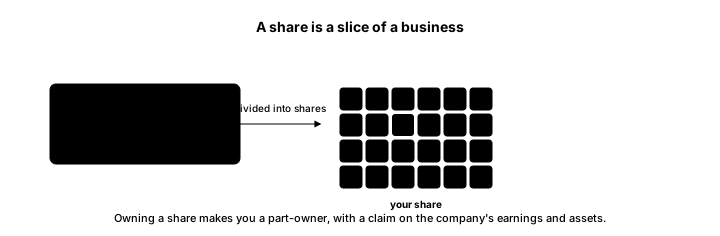
You learned in Stock Market Basics that a share is not a lottery ticket or a number on a screen. It is a small piece of ownership in a real company, with real revenues, real profits, and real assets. If you own one share out of a company's ten crore shares, you own one ten-croreth of that entire business: its factories, its brand, its bank balance, and its yearly profit.
That single idea is the foundation of everything in this course. If a share is a slice of a business, then what the share is worth must depend on what the business is worth. A stock is not valuable because its price has been rising, or because someone on television is excited about it. It is valuable because the business behind it earns money, owns things, and is likely to keep doing so. Fundamental analysis is the work of judging that.
What fundamental analysis is
Fundamental analysis is the study of a business, its earnings, its assets, its debts, its competitive position, and the quality of the people running it, in order to estimate what its shares are really worth. An analyst reads the company's financial statements, works out a handful of telling ratios, judges the strength and durability of the business, and arrives at a view: this company is worth roughly so much, so its shares are worth roughly so much each.
It helps to see fundamental analysis beside its counterpart, technical analysis, which had its own course earlier in this catalogue. Technical analysis studies the price chart and volume to judge the timing of a trade: when might this move, and where. Fundamental analysis ignores the chart almost entirely and studies the business to judge worth: what is this actually worth to own. They are not rivals, because they answer different questions for different people. The trader asks when. The investor, the person this course is written for, asks what a thing is worth, and whether the market is offering it for less.
The question, in numbers
Return to the tea stall, because a listed company is the same question at a larger scale. A stall earning 3,00,000 a year, offered at 6,00,000, is priced at two years of profit. Investors have a name for that multiple, the price divided by the yearly profit, which you will meet properly later as the price-to-earnings ratio. At two years of profit it looks cheap; at twenty years, or 60,00,000, it looks dear, unless the profit is set to grow a great deal.
Now scale it up. Imagine a listed company with ten crore shares trading at 500 rupees each, so the market values the whole business at 5,000 crore rupees, its market capitalisation from Stock Market Basics. Suppose the company earns 250 crore rupees of profit a year. Each share is then backed by 25 rupees of annual profit, its earnings per share, and at a price of 500 you are paying twenty years of profit for it, exactly like the expensive version of the stall. Turn that around, and 25 rupees of profit on a 500 rupee price is an earnings yield of 5%, the return the business's profit represents on your purchase price. (All figures illustrative.) You do not need to judge yet whether twenty years is too much to pay. You only need to see that fundamental analysis turns a share price into a question about a business you can actually reason about.
What it can and cannot do
Be clear from the start about what this analysis is for, because the honesty of the whole course depends on it. Fundamental analysis estimates what a business is worth. It does not predict what its share price will do next week, next month, or even next year. Price and value can drift apart for a long time, which is the investor's opportunity but also their test of patience.
And the information you will study, the financial statements and the ratios, is public. Everyone can read it, so no single number is a secret buy signal, and the market has usually already reacted to the obvious facts. Your edge, if you have one, comes from reading the business more carefully than the crowd, taking a longer view than the crowd can bear to, and having the temperament to act when others are fearful or greedy. That is hard, honest work, and it is the opposite of the tips and sure-thing calls the market is full of.
What to carry forward
A share is a slice of a business, so its worth is the business's worth, and fundamental analysis is the disciplined study of that business, the investor's counterpart to the trader's technical analysis. It turns a share price into a question you can reason about, as with the stall priced at two years of profit against twenty. But it estimates value rather than predicting price, using public information, so the reward goes to careful judgement and patience, not to secret signals.
All of this rests on a distinction we have used loosely and must now make sharp: the difference between what a share costs and what it is worth. The next chapter draws that line clearly, and with it the single most important idea in investing, the margin of safety.