Course contents
Earnings, growth, and your slice
Ratios rest on per-share figures, above all earnings per share, and on how fast those figures are growing. Growth matters, but only alongside the price you pay for it, because overpaying for growth is a classic way to lose money.
- Define earnings per share and book value per share, and how corporate actions change them
- Explain revenue and profit growth rates and why consistency matters
- Connect growth to valuation, since a fair price for growth is not any price
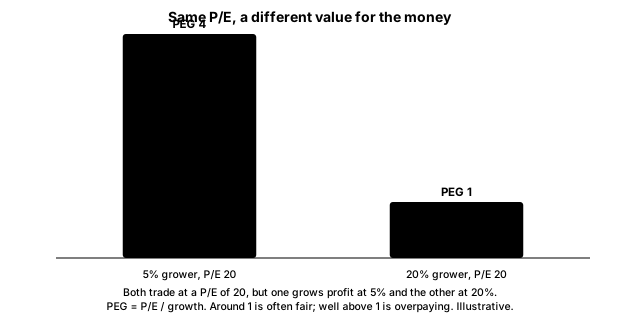
Two companies both trade at a P/E of 20. The first is growing its profit at 5% a year, the second at 20%. Priced the same on today's earnings, they are not remotely the same value, because the second company's profit, and the earnings behind that P/E, will be far larger in a few years. Growth changes what a multiple is worth. This chapter is about measuring that growth, and about the trap of paying for it without limit.
Per-share figures: your actual slice
Ratios and growth both rest on per-share numbers, because you own shares, not the whole company. You met the two that matter. Earnings per share, or EPS, is the net profit divided by the number of shares: our manufacturer's 120 crore of profit on 10 crore shares is an EPS of 12 rupees. Book value per share is the equity divided by the shares: its 400 crore of equity is a book value of 40 rupees a share.
One caution on per-share figures. The number of shares can change, and when it does, the per-share numbers change with it even if the business does not. A bonus issue or a stock split, which you met in Stock Market Basics, raises the share count and mechanically lowers EPS per share without making the company any poorer, while a company issuing fresh shares to raise money dilutes each existing share's slice of the profit. Always check whether a change in EPS came from the business or merely from the share count.
Measuring growth
Growth is usually quoted two ways. The year-on-year growth compares this year with the last: our manufacturer grew profit from 100 crore to 120, a 20% year-on-year rise. But a single year can be lumpy, so investors prefer the compound annual growth rate, or CAGR, the steady yearly rate that would take the figure from its start to its finish over several years. Our manufacturer's profit grew from 60 crore to 120 over six years, a doubling, which is a CAGR of about 12% a year. CAGR smooths out the good and bad years into one comparable rate, and it is the honest way to describe growth over time.
What you are really looking for is not a single spectacular year but consistency: revenue and profit growing steadily, year after year, at a healthy rate. A company that grew 80% one year and shrank the next is far less valuable, and far riskier, than one that compounds at a steady 15%, because the steady grower is predictable and the lumpy one may be riding a cycle or a one-off.
Wait for growth to be backed by the earlier chapters, too. Growth funded by ever more debt, or reported as profit but not turning into cash, is low-quality growth. The best growth comes with steady margins, a high return on capital, and cash flow that keeps pace.
Growth at a price, not at any price
Now the trap. Because growth makes future earnings larger, it is worth paying a higher multiple for a faster-growing company, and the market does. The danger is paying too high a multiple, on the assumption that rapid growth will continue for years, when it may not. Overpaying for growth is one of the most common ways careful-seeming investors lose money, because when the growth slows, both the earnings and the rich multiple fall together, a double blow.
A rough gauge ties growth to price: divide the P/E by the growth rate. Our manufacturer at a P/E of 20, growing profit at 20%, gives a ratio of about 1, which many investors treat as a reasonable, fair price for that growth. Much above 1, and you may be paying too dearly for growth that has to be flawless to justify the price; comfortably below 1 can signal growth available cheaply. Treat this only as a rough sanity check, not a precise rule, because it leans on a growth estimate that is itself a guess, and slow, steady growth deserves a different reading from fragile, fast growth.
This is the last chapter's lesson from the other side. A ratio like the P/E is only sensible in the light of growth, and growth is only worth having at a sensible price. The two must always be judged together.
What to carry forward
Growth decides what a valuation multiple is really worth, so the two must be judged together. Measure it honestly with CAGR rather than a single year, prize steady, cash-backed, high-return growth over a lumpy spurt, and remember that per-share numbers can move with splits, bonuses, and dilution. Above all, growth is worth a higher price only up to a point: overpaying for growth that later fades is a classic and painful error, because the earnings and the rich multiple fall together.
You have now measured a business's quality, its price, and its growth. One dimension of the numbers remains, the one that decides whether a company survives a bad year at all: its debt. The next chapter turns to debt and financial health.