Course contents
Can the business survive a bad year
Debt magnifies a company's results and its risks, exactly as leverage does for a trader. The debt-to-equity ratio and interest coverage show whether a business is carrying more debt than it can safely service, which is how apparently sound companies fail.
- Define debt-to-equity and interest coverage and read them from the statements
- Explain how debt magnifies both returns and the risk of failure
- Give a beginner's sense of healthy versus dangerous debt, with the caveat that norms differ by industry
If you read the Futures and Risk courses, you already understand this chapter's core idea, because a company's debt does to the company what leverage does to a trader. It magnifies the good years, when the business earns more than the debt costs, and it magnifies the bad ones, when the debt still demands to be paid whether or not the business earned anything. Debt is why companies that looked perfectly sound in good times fail suddenly in bad ones, and reading a company's debt is how you judge whether it can survive a downturn.
Debt-to-equity: how much is borrowed
The first measure is the debt-to-equity ratio, or D/E: the company's total debt divided by its shareholders' equity. It says how much the business has borrowed against how much the owners have put in.
Our illustrative manufacturer carries 400 crore of debt against 400 crore of equity, a debt-to-equity ratio of 1.0. For each rupee of owners' capital, there is one rupee of borrowed money. A D/E around or below 1 is generally comfortable for an ordinary industrial company; a D/E of 2 or 3 means the business leans heavily on borrowing, which lifts returns when times are good, as the profitability chapter showed, and threatens survival when they are not.
Interest coverage: can it pay the interest
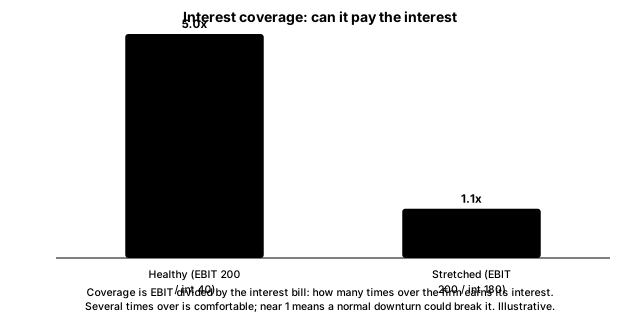
D/E tells you how much debt there is; interest coverage tells you whether the company can comfortably service it. It is the operating profit (EBIT) divided by the interest bill: how many times over the business earns its interest.
Our manufacturer earns an EBIT of 200 crore against an interest bill of 40, an interest coverage of 5 times. It could lose four-fifths of its operating profit and still cover its interest, which is healthy. Now picture a company with the same 200 of EBIT but 180 of interest, because it borrowed far more. Its coverage is barely 1.1 times. In a good year it scrapes through, but let a normal downturn cut its profit by even a quarter and it can no longer pay its lenders, which is the doorway to default and, eventually, bankruptcy. Interest coverage is often a better early-warning sign than D/E itself, because it measures the strain the debt actually puts on the business.
The current ratio: paying the short-term bills
A company can be solvent over the long term and still be caught short of cash for its immediate dues, so one more measure watches the short term. The current ratio is current assets divided by current liabilities, the things that will become cash within a year against the bills due within a year. Our manufacturer holds 400 crore of current assets against 200 of current liabilities, a current ratio of 2.0, meaning twice the short-term cover. A ratio comfortably above 1 suggests the company can meet its near-term obligations; a ratio below 1 means its short-term dues exceed its short-term resources, a possible cash squeeze ahead.
Healthy debt, dangerous debt, and the industry caveat
Some debt is normal and even sensible, because borrowing at a lower cost than the business earns on capital lifts the owners' returns. The danger is not debt itself but too much of it, and debt the business cannot service through a bad year. The combination to fear is high debt-to-equity together with thin interest coverage, because that is a company with no margin for a downturn.
Two important caveats. First, what counts as safe differs sharply by industry. Banks and other lenders are, by their very nature, highly borrowed, because lending is their business, and they are judged by entirely different capital rules rather than by ordinary D/E. Capital-heavy businesses like infrastructure carry more debt than an asset-light software firm ever would. So compare a company's debt only with its own history and its true peers. Second, not all obligations sit on the balance sheet as debt: the contingent liabilities and commitments disclosed in the notes, which you met in the annual-report chapter, can hide real risk, so a careful reader checks them before concluding a company is lightly borrowed.
What to carry forward
Debt magnifies a business exactly as leverage magnifies a trade: it lifts the good years and can sink the company in a bad one. Debt-to-equity measures how much has been borrowed, interest coverage whether the profit can service it, and the current ratio whether the short-term bills can be met, with the truly dangerous case being heavy debt paired with thin coverage. Judge all of it against the company's own past and its industry, and remember that some obligations hide in the notes rather than on the balance sheet.
That completes the numbers: you can now measure a business's profitability, its price, its growth, and its financial health. But numbers only describe the past. Whether a good business will still be good in ten years is a matter of judgement, not arithmetic. Part 4 turns to that judgement, beginning with the durable advantage that keeps a business strong: its economic moat.