Course contents
The business does not stand alone
A company lives inside an industry and an economy, and both can lift or sink it regardless of its own quality. Understanding the industry's structure and where it sits in its cycle, and the difference between cyclical and defensive businesses, keeps you from mistaking a good year for a good business.
- Explain top-down versus bottom-up analysis and how the economy and sector affect a company
- Distinguish cyclical from defensive industries with Indian examples
- Warn against valuing a cyclical at the peak of its cycle
A strong swimmer caught in a riptide still gets pulled backward, because the water matters as much as the swimmer. A company is the same. However good the business, it swims inside an industry and an economy that can carry it forward or drag it back regardless of how well it is run. You cannot judge a company in isolation from the water it swims in.
Top-down and bottom-up
There are two directions from which to approach a company. Bottom-up analysis starts with the individual business, its statements, ratios, moat, and management, which is most of what this course has taught. Top-down analysis starts from the big picture, the economy and then the industry, and works down to the companies that will benefit. The two are not opposed, and a good investor uses both: you study the company closely, bottom-up, but you never forget to look up and ask what its industry and the economy are doing to it.
Industry structure matters because it shapes how much profit is even available to compete for. An industry with few players, high barriers to entry, and real pricing power lets its companies earn good returns, while a brutally competitive industry with no barriers, where everyone undercuts everyone on price, grinds returns down for all of them. A good company in a terrible industry has a permanent headwind, and the moats from the last chapter are often really features of the industry as much as the firm.
Cyclical and defensive businesses
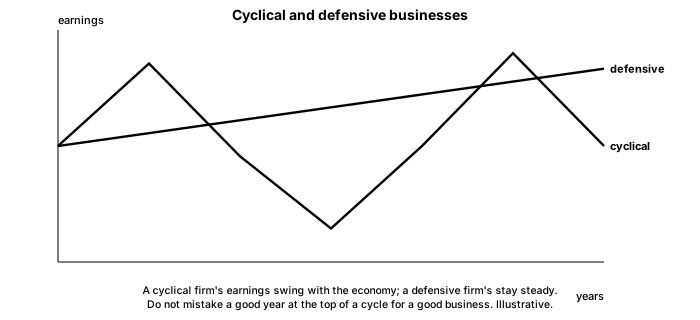
Industries differ enormously in how much their fortunes swing with the economy, and the difference is one of the most useful distinctions in investing.
Cyclical businesses boom and slump with the economic cycle. When the economy is growing, people and companies buy cars, build factories and homes, and consume steel, cement, and capital goods, so the profits of automakers, metal producers, cement companies, and real-estate firms surge. When the economy turns down, those same purchases are postponed, and their profits collapse. Their earnings are a rollercoaster.
Defensive businesses sell things people buy in good times and bad, so their demand, and their profit, is far steadier. People keep buying soap, food, and medicine whatever the economy does, which is why consumer-staples (FMCG), pharmaceutical, and utility companies are called defensive. They rarely soar, but they rarely crash either.
Neither kind is better in the abstract, but they must be analysed and valued very differently, and confusing the two is a costly mistake.
The cyclical trap in the P/E
Here is where the distinction bites, and it catches many beginners. Recall that the P/E ratio uses this year's earnings. For a cyclical business, that is treacherous, because its earnings are highest exactly at the top of the cycle and lowest at the bottom.
Picture a steelmaker at the peak of a boom, earning an EPS of 40 with its shares at 400: a P/E of just 10, which screams "cheap". But those peak earnings are about to fall as the cycle turns, and when they do, both the earnings and the price drop. Now picture the same company at the bottom of the cycle, earning an EPS of only 5 with its shares at 200: a P/E of 40, which looks "expensive". Yet the price is actually lower, and the earnings are about to recover. The lesson is upside down from instinct: for a cyclical, a low P/E on peak earnings is often the moment of greatest danger, and a high P/E on depressed earnings can be the moment of opportunity. This is why cyclicals are judged not on a single year's P/E but on normalised, through-the-cycle earnings, or on measures like price-to-book that do not swing with the cycle.
The macro forces to watch
Finally, some economy-wide forces move whole groups of companies at once, and an Indian investor should keep an eye on them. Interest rates set by the central bank raise or lower the cost of debt, which hits borrowers and rate-sensitive sectors like real estate and autos. Commodity prices swing the input costs of manufacturers and the revenues of producers. The rupee's exchange rate helps exporters, such as IT and pharmaceutical companies earning in dollars, and hurts importers when it weakens. And government policy and regulation, which matter greatly in India, can remake an entire sector with a single decision, a tax change, a new rule, an opened or closed market. You do not need to forecast these, but you must know which of them your company is exposed to.
What to carry forward
A business does not stand alone: its industry's structure and its place in the economic cycle can lift or sink it regardless of its own quality, so combine close bottom-up study with a top-down eye. Cyclical businesses swing with the economy and defensive ones do not, and the two demand different valuation, most sharply in the cyclical P/E trap, where peak earnings make a stock look cheapest just before it falls. Keep watch on the interest rates, commodity prices, currency, and policy that move whole sectors at once.
You have now judged a business from every angle: its numbers, its moat, its managers, and its industry. What remains is to put a value on it and decide whether to buy. Part 5 turns to valuation and the investment decision, beginning with intrinsic value and the margin of safety that has run quietly under this whole course.