Course contents
The three views of a business
Every listed company publishes three linked statements, the income statement (what it earned), the balance sheet (what it owns and owes), and the cash flow statement (where the cash moved). Together they are three views of the same business, and they connect.
- Name the three statements and what each answers
- Explain in plain terms how they link
- Introduce consolidated versus standalone accounts in the Indian context
No single number can tell you whether a business is healthy, any more than a single reading can tell a doctor whether a patient is well. You need to see it from more than one angle. That is exactly why every listed company must publish not one financial statement but three, and why learning to read all three together, rather than fixating on the profit figure alone, is the first real skill of fundamental analysis.
Three statements, three questions
Each of the three statements answers a different question about the business.
The income statement, also called the profit and loss account or P&L, answers: how much did the company earn over a period, say a quarter or a year? It runs from sales at the top down to profit at the bottom.
The balance sheet answers: what does the company own, and what does it owe, on a single date? It is a snapshot of the company's financial position at the close of the period.
The cash flow statement answers: where did the cash actually come from and go, over the period? It tracks the real money moving in and out, which, as a later chapter shows, is not the same as profit.
One is a record of performance over time, one is a photograph at a moment, and one follows the cash. Read together they describe a business; read alone, any one of them can mislead.
How the three connect
The three are not separate documents. They are three views of one business, and they link, which is why a weakness hidden in one often shows up in another.
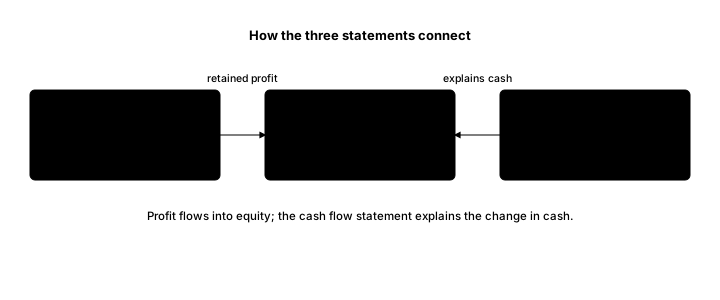
Take an illustrative company we will follow through this part, a mid-sized manufacturer (all figures illustrative, in crore rupees). Its income statement this year ends in a net profit of 120. That profit does not vanish. The company pays out 40 as dividends to shareholders and keeps the remaining 80, which is added to the reserves inside equity on the balance sheet, so the owners' stake grows by 80. That is the first link: profit from the income statement flows into equity on the balance sheet.
The second link runs through cash. The cash flow statement for the year shows the company's cash rising by 10, and that 10 is exactly the change in the cash line on the balance sheet, from 90 at the start of the year to 100 at the end. The cash flow statement, in other words, explains the change in one of the balance sheet's own numbers. When the statements do not tie together like this, something is wrong, and knowing they should link is part of what protects you.
Standalone and consolidated, and where to find them
In India you will usually see each statement in two versions, and the difference matters. The standalone statements cover only the parent company on its own. The consolidated statements combine the parent with its subsidiaries, the other companies it controls, into one picture. For any group with significant subsidiaries, the consolidated statements are the truer view of the whole business, and they are the ones to read first.
The statements are prepared under Ind AS, the Indian Accounting Standards, a common rulebook that keeps companies broadly comparable with one another. You will find all three statements, in both versions, in the company's annual report and in its quarterly results, published on its own website and on the stock exchanges. The next chapters take the three apart one at a time, and the last chapter of this part shows you where the story around them is really told.
What the statements are, and are not
Two honest cautions before you start reading. First, the statements look backward. They tell you, in detail, what the business has already done, not what it will do, and a company's past is only a guide to its future, never a guarantee. Second, they are prepared by the company, within the rules but with real choices along the way about how to value things and when to record them. The rules limit those choices, and the auditor checks them, but a determined management still has room to flatter the picture. That is precisely why you read all three statements together, and why you read the notes and the auditor's report that accompany them, which the last chapter of this part covers.
What to carry forward
The three statements are three views of one business: the income statement for performance over a period, the balance sheet for what is owned and owed on a date, and the cash flow statement for the money that actually moved. They link, profit flowing into equity and cash flow explaining the change in cash, so reading them together is what keeps any one of them from fooling you. In India, favour the consolidated version, prepared under Ind AS.
Now we take them one at a time, starting with the one everyone quotes and fewest people read properly: the income statement, and the journey from a company's sales down to its profit.