Course contents
Cash is the truth, profit is an opinion
A company can report a profit and still run out of cash, because profit includes non-cash items and timing choices. The cash flow statement, split into operating, investing, and financing, shows the money that actually moved, which is harder to dress up.
- Explain why profit and cash differ
- Read the three sections of the cash flow statement
- Explain why strong, consistent operating cash flow is a sign of a healthy business
A company can report a healthy profit and still collapse, and companies do. The reason is the most important idea in reading financial statements: profit is not cash. A business pays its salaries, its suppliers, and its loans in cash, not in profit, and if the cash runs dry it fails, however handsome the profit on paper. Investors have a blunt version of this: profit is an opinion, cash is a fact.
Why profit and cash are different
Several things drive a wedge between the profit on the income statement and the cash in the bank.
Some costs in the profit calculation are not cash leaving this year, above all depreciation, the charge that spreads an old purchase across many years. It reduces profit without any money moving, so real cash is higher than profit by that amount.
Some sales in the profit calculation have not been paid for yet. When a company sells on credit, it books the revenue, and the profit, immediately, but the cash arrives later, if at all. A company can show rising profit while its customers' unpaid bills, its receivables, swell and little cash comes in.
And money spent building the business, buying a new machine or piling up inventory, uses cash without reducing profit in the same way. So profit and cash routinely differ, and the cash flow statement exists to show the cash, which is far harder to dress up.
The three sections
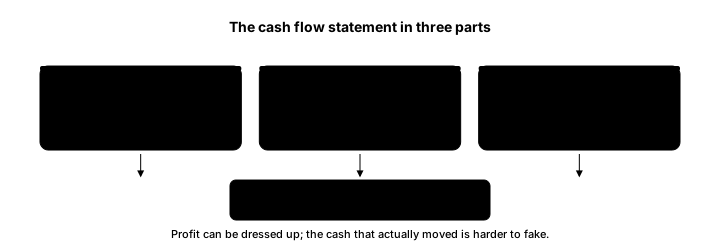
The cash flow statement sorts every rupee of cash movement into three buckets.
Cash from operating activities, or CFO, is the cash the core business generated from its day-to-day operations. It starts from profit and adjusts for the non-cash charges and the timing differences above. This is the most important line in the whole statement, because it is the cash the business actually produces by operating.
Cash from investing activities, or CFI, is cash spent on or received from long-term assets, above all capital expenditure (capex), the money spent on new plant and equipment. For a growing company this is usually negative, because it is investing.
Cash from financing activities, or CFF, is cash exchanged with the providers of capital: raising or repaying debt, issuing shares, and paying dividends.
Following the cash
Take our manufacturer through it (crore rupees, illustrative). Its net profit was 120. Add back the 50 of depreciation, which never left as cash, and subtract 30 that got tied up in higher working capital (more inventory and receivables), and its cash from operations is 140, comfortably more than its profit. It spent 90 on new machinery, so investing cash flow is minus 90. It paid 40 in dividends, so financing cash flow is minus 40. Add the three, 140 minus 90 minus 40, and the cash rose by 10 over the year, which is exactly the move from 90 to 100 in the cash line on its balance sheet. The statements tie together.
Notice a useful figure hiding in there. The operating cash of 140, less the 90 of capex needed to keep the business running and growing, leaves 50 of free cash flow, the cash genuinely left over for the owners after the business has been fed. Free cash flow, not accounting profit, is what ultimately pays dividends and builds value.
When cash tells a different story
The reason the cash flow statement matters so much is that it catches trouble the profit line hides. Imagine a second company reporting the same 120 of profit and 50 of depreciation, so it looks identical on the income statement. But its customers are not paying, and its receivables balloon by 200 over the year. Its cash from operations is then 120 plus 50 minus 200, which is minus 30. It is reporting a healthy profit while its operations bleed cash. That gap, rising profit with weak or negative operating cash flow, is one of the clearest warning signs in all of fundamental analysis, and it is invisible unless you read the cash flow statement.
The healthy pattern is the opposite: steady profit backed by operating cash flow that is consistently as large or larger, showing that the profit is real and turning into money.
Cash is harder to fake, not impossible
Cash flow is the most reliable of the three statements, because cash movements are harder to shape with accounting choices than profit is. That is why experienced investors look at cash from operations before they trust the profit line. But harder is not impossible, and even cash flows can be managed for a while, by delaying supplier payments or stretching other timing, so you still read it across several years and alongside the other two. The point is not that cash flow is infallible. It is that a business that reports profit but cannot produce cash deserves your deep suspicion, whatever its bottom line says.
What to carry forward
Profit is an opinion, cash is a fact: a company can report profit and still run out of the cash it actually pays its bills with, so the cash flow statement, split into operating, investing, and financing, is where you check whether the profit is real. Operating cash flow is the line that matters most, and profit reported alongside weak or negative operating cash is a serious warning, as our second company showed. Free cash flow, operating cash less capex, is the cash truly left for the owners.
You can now read all three statements. The last chapter of this part shows you the document they live inside, the annual report, and where in it the honest story, the risks, the caveats, the related-party dealings, is actually told.