Course contents
What a business is really worth, and buying below it
Intrinsic value is what a business is worth based on the cash it will generate over its life. You do not need heavy mathematics to use the idea, estimate value conservatively, then buy well below it, so that being wrong still leaves you safe. That gap is the margin of safety.
- Explain intrinsic value as the worth of a business's future cash, and discounting in plain terms without heavy formulae
- Define the margin of safety and why it is the investor's core protection
- Stress that every valuation is an estimate, so conservatism matters more than precision
The whole course has been walking toward this question. You have judged a business's profitability, its price, its growth, its debt, its moat, its managers, and its industry. Now comes the point of all that work: what is the business actually worth, and is the market offering it for less? The answer rests on the idea of intrinsic value, and on the one habit that keeps an investor safe when the estimate is wrong, the margin of safety.
What intrinsic value means
The intrinsic value of a business is what it is truly worth, based on all the cash it will generate for its owners over its life. A business is worth the money it will hand you in the years ahead, no more and no less, so its value today is the value today of all that future cash.
That phrase, "value today of future cash," carries a wrinkle you already know from everyday life: money in the future is worth less than money now. A hundred rupees in your hand today can be invested to become more than a hundred next year, so a hundred promised a year from now must be worth less than a hundred today. Turning a future amount into its worth today is called discounting. At a required return of 12%, for instance, 112 rupees a year from now is worth exactly 100 today, and 100 rupees a year from now is worth about 89. The further out the cash, and the higher the return you demand, the more it is discounted.
A rough estimate, on purpose
Add up the discounted value of all the cash a business will produce, and you have an estimate of its intrinsic value. Done in full, with year-by-year forecasts, this is called a discounted cash flow, and this course deliberately does not turn it into a spreadsheet, because the false precision does more harm than good for a beginner.
Instead, hold the idea in a simple form. Suppose a steady business will produce about 50 crore rupees of free cash flow a year, the free cash you met in the cash-flow chapter, and you want a 12% return. Capitalising that cash, dividing it by your required return, gives a rough worth of 50 divided by 0.12, or about 417 crore rupees. If you expect the cash to grow over time, the business is worth more than that; if it is shrinking, less. You do not need the exact figure. You need a conservative, sensible sense of the range, because what protects you is not the precision of the estimate but what you do with it.
The margin of safety
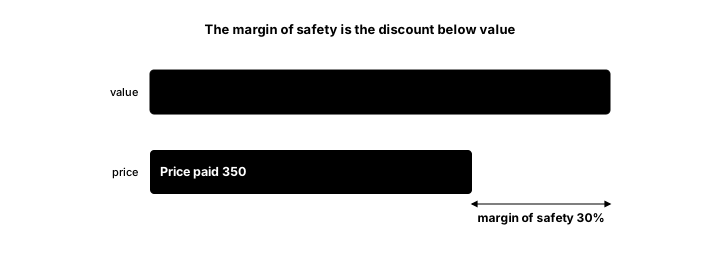
Here the course closes the circle back to the second chapter. Because every valuation is an estimate built on assumptions about an unknowable future, you never pay right up to your estimate of value. You demand a discount, the margin of safety, so that even if your estimate is too optimistic, you have not overpaid.
Put it together. If your conservative estimate says a business is worth about 417 crore, and the market is offering the whole company at 300 crore, you are buying at roughly a 28% discount to your estimate of value, a real margin of safety. Or, per share, if you judge a share worth about 500 rupees and the market's fear lets you buy at 350, your margin of safety is 30%. If your valuation turns out to have been 15 or 20% too high, the margin still leaves you whole. The margin of safety is what turns a rough estimate into a safe decision, and it is the single most important discipline in investing, which is why this course has returned to it from the very start.
Conservatism beats precision
One honest warning seals the idea. A discounted cash flow can be made to say almost anything, because small changes in the growth and discount assumptions swing the answer enormously, and it is tempting to tweak them until the model agrees with the price you already wanted to pay. Resist that entirely. The goal is not a precise number but a conservative one, an estimate that deliberately errs low, paired with a margin of safety that protects you when you are wrong, which you sometimes will be. An investor who is roughly right and buys with a wide margin of safety will do far better than one who is precisely wrong and pays full price for it.
What to carry forward
Intrinsic value is what a business is worth from the cash it will hand its owners over time, discounted back to today, and you estimate it conservatively rather than precisely, because the future is unknowable. You then never pay up to that estimate: you demand a margin of safety, buying well below it, so that even a mistaken valuation leaves you safe. That single discipline, buy below a conservative estimate of worth, is the heart of investing.
Estimating intrinsic value from scratch is real work, so in practice investors also lean on a faster method: comparing a company with its peers and its own past, and using screens to find candidates. The next chapter covers that relative valuation and screening, and where each one can mislead.