Course contents
What a thing costs is not what it is worth
The price is what the market is asking today; the value is what the business is actually worth. They are often different, and the whole of investing is buying when price is below value, with a margin of safety to protect you when your estimate is wrong.
- Distinguish price from intrinsic value with a plain example
- Introduce the market as a moody counterparty whose quotes you can accept or ignore
- Introduce the margin of safety as buying below value
Imagine you own a business jointly with a partner, and this partner has a peculiar habit. Every single day, without fail, they knock on your door and name a price: sometimes offering to buy your half from you, sometimes offering to sell you theirs. The trouble is that your partner is wildly moody. On a sunny, optimistic day they are euphoric and quote a very high price. On a gloomy, frightened day they will offer to sell you their share for a pittance. The business itself has not changed between those two days; only the partner's mood has. This picture of the market as a moody partner is a famous one among investors, and it holds the whole secret of price against value.
Here is the freedom in the story, and it is the investor's greatest advantage. Your moody partner's quote is an offer, not a verdict. You are never obliged to trade. When they are euphoric and the price is silly, you can smile and decline, or even sell them your share at their inflated price. When they are terrified and the price is absurdly low, you can buy from them cheaply. Their mood does not tell you what the business is worth. It only tells you what price is available today, which is a different thing entirely.
Two different numbers
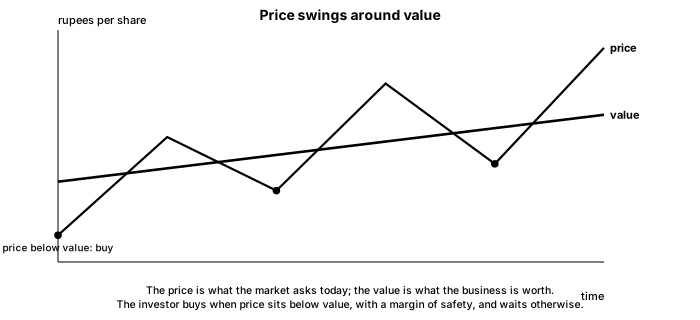
Investing rests on separating two numbers that beginners treat as one. The price is what the market is asking for a share right now, the number on the screen, set by the moods and guesses of millions of buyers and sellers. The value, or intrinsic value, is what the share is actually worth, based on the business behind it, its profits, assets, and prospects, which you learned to ask about in the last chapter.
In the short run the two can be far apart, because price is driven by emotion and news and the crowd's mood, while value changes slowly with the business. A company worth, on a sober assessment, about 500 rupees a share might trade at 650 when the market is enthusiastic about its sector, and at 350 when the same market is gripped by fear, even though the business is the same on all three days. The entire craft of investing is to estimate value, then use the gap between price and value that your moody partner keeps offering.
Buy below value: the margin of safety
If you could estimate value perfectly, the rule would be simple: buy whenever price is below value. But you cannot. Any estimate of what a business is worth is exactly that, an estimate, built on assumptions that may prove wrong. So the great investors add a cushion, and it is the most important idea in this course.
Suppose your careful work says a share is worth about 500 rupees. You do not buy it at 495 just because that is a hair below your estimate, because if your estimate is even slightly too optimistic, you have no protection. Instead you wait for the market's fear to offer it at, say, 350, a 30% discount to your estimate of value. That 30% gap is the margin of safety: the buffer between the price you pay and the value you believe you are getting. If your valuation was right, you have bought cheaply. If your valuation was 10 or 20% too high, the margin of safety means you still have not overpaid. It turns being roughly right into being safe.
The same logic tells you to decline the euphoric price. When your partner offers 650 for something you value at 500, there is no margin of safety at all, only a margin of danger, and the honest move is to say no, however exciting the story around the stock.
The catch: value can stay ignored
There is a hard part, and pretending otherwise would break the honesty of this course. The market can keep a price below your estimate of value for a long time, sometimes years, and it can hold a price far above value for just as long. Being right about value does not pay off on a schedule. This is why fundamental analysis suits the patient investor and punishes the impatient one. You may buy a genuinely cheap share and watch it stay cheap, or get cheaper, before the gap ever closes.
That patience is not a minor detail; it is the price of admission, and it is where the Risk and Psychology course meets this one. You need the temperament to buy when the mood is fearful and the price is low, which is exactly when it is hardest, and to wait, calmly, when nothing seems to be happening. The margin of safety protects your capital while you wait. Your temperament decides whether you can wait at all.
What to carry forward
The market is a moody partner offering you prices, not verdicts: price is what it asks, value is what the business is worth, and the two drift apart with the crowd's mood. The investor estimates value and buys only at a meaningful discount to it, the margin of safety, so that being roughly right is enough to be safe, and declines the euphoric prices that offer no cushion. The catch is that value can stay ignored for a long time, so this craft rewards patience and temperament above all.
That long horizon is exactly what separates the investor from the trader, and it decides which tools each one needs. The next chapter draws that line, and shows why fundamental analysis is the investor's tool rather than the trader's.