Course contents
What the business owns and owes
The balance sheet is a snapshot of what a company owns (assets), what it owes (liabilities), and what is left for the owners (equity), on a single date. It shows the financial strength that decides whether a business can weather a bad year.
- Explain the balance-sheet identity in plain terms
- Distinguish current from non-current items and equity from debt
- Read a simple Indian balance sheet and say what it reveals
If the income statement is a video of everything the company did over a year, the balance sheet is a single photograph, taken at the close of the last day. It does not show what the company earned. It shows what the company is: everything it owns, everything it owes, and what is left over for the owners, frozen at one moment.
The one equation the balance sheet obeys
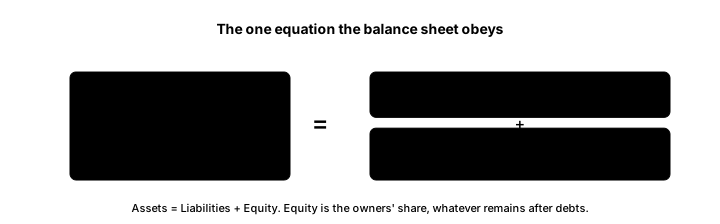
The balance sheet is built on a single equation that always holds, which is why it is called a balance sheet:
Assets = Liabilities + Equity
In plain words: everything a company owns (its assets) was paid for either with money it borrowed or owes (its liabilities) or with money belonging to the owners (its equity). The two sides must be equal, because every rupee of assets came from one of those two sources. If you own a 50 lakh flat with a 30 lakh home loan, your asset is 50, your liability is 30, and your own equity in it is 20. A company is the same idea at scale.
What a company owns
The asset side lists what the company controls, usually split into two groups. Current assets are things that are cash or will become cash within about a year: the cash itself, money owed by customers (receivables), and inventory waiting to be sold. Non-current assets are the long-lived ones, above all property, plant, and equipment (PP&E), the factories and machines, along with investments and intangible assets.
Our illustrative manufacturer holds, in crore rupees, 100 of cash and 300 of other current assets (its receivables and inventory), and 600 of net fixed assets, its plants and machinery after depreciation. Its total assets are 1,000.
What a company owes, and what is left
The other side splits into what the company owes others and what belongs to the owners. Current liabilities are dues within a year, such as money owed to suppliers (payables). Longer-term obligations include debt, the borrowings on which it pays interest. Whatever is left after subtracting all liabilities from all assets belongs to the shareholders and is called equity, made up of the capital originally raised and the reserves, the profits retained over the years, including the 80 our company kept this year.
Our manufacturer owes 200 in current liabilities and carries 400 of debt, and its equity is 400. Add them: 200 plus 400 plus 400 is 1,000, exactly matching its assets. The sheet balances, as it must.
What the balance sheet tells you
This snapshot reveals the financial strength that the income statement cannot. Two things stand out even before the formal ratios of Part 3. First, how the company is financed: our manufacturer carries 400 of debt against 400 of equity, an even split, so borrowings fund as much as the owners have put in, a figure the debt chapter will turn into the debt-to-equity ratio. Second, whether it can pay its short-term bills: it holds 400 of current assets against 200 of current liabilities, twice the cover, which the same chapter will call the current ratio. A company drowning in debt, or one whose short-term dues dwarf its current assets, is fragile however large its profit, and the balance sheet is where you see it.
Book value is not market value
One caution keeps the balance sheet honest. The values on it are largely book values, based on what things originally cost, less depreciation, not what they would fetch today. A piece of land bought decades ago may sit on the books at a tiny fraction of its real worth, so the balance sheet can understate a company. In the other direction, some of a company's most valuable things, a trusted brand, a skilled workforce, do not appear on the balance sheet at all, because they were never bought. So the equity figure, often called the company's book value, is an accounting number, not the price the business would sell for. It is a useful anchor, not a valuation.
What to carry forward
The balance sheet is a snapshot on one date, obeying a single equation: assets equal liabilities plus equity, because everything a company owns was funded either by what it owes or by the owners' stake. It splits into current and non-current items on each side, and it reveals the financial strength, the debt load and the short-term cover, that the profit figure hides. Remember that its values are book values, historical and incomplete, not market prices.
The income statement showed profit and the balance sheet showed position, but neither shows the thing a business actually lives or dies on: cash. The next chapter follows the money itself, and explains why profit is an opinion and cash is a fact.