Course contents
How well the business turns capital into profit
The best businesses earn a high return on the money invested in them. Return on equity and return on capital employed measure that, and a durably high return is one of the strongest signs of a quality business.
- Define return on equity (ROE) and return on capital employed (ROCE) and compute them from the statements
- Explain why a high, consistent return signals quality
- Warn that debt can flatter ROE, which ROCE helps expose
Two companies each earn a net profit of 120 crore rupees this year. The first used 400 crore of owners' capital to do it; the second needed 2,000 crore. On the income statement they look identical, both posting 120 of profit. As businesses they are worlds apart: the first turned its owners' money into a 30% return, the second only 6%. Profit alone never tells you how good a business is. What tells you is how much capital it took to earn that profit, and that is what this chapter measures.
Return on equity
The first and most quoted measure is return on equity, or ROE: the net profit expressed as a percentage of the shareholders' equity, the owners' capital in the business. It answers the owner's question directly: for every rupee of my money in this company, how much profit does it earn a year?
Take our illustrative manufacturer from the last part. Its net profit was 120 crore and its equity was 400 crore, so its ROE is 120 divided by 400, which is 30%. Every rupee of owners' capital is generating 30 paise of profit a year, a strong figure. A business that can sustain a high ROE over many years is compounding its owners' wealth quickly, which is why ROE is one of the first numbers a serious investor looks at.
Return on capital employed
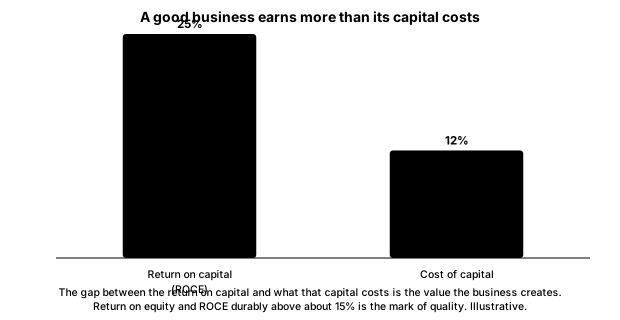
ROE has a blind spot, and the second measure closes it. A company funds itself with both owners' equity and borrowed debt, and ROE looks only at the equity part. Return on capital employed, or ROCE, widens the lens to all the long-term capital in the business, debt and equity together, and measures the operating profit (EBIT) it earns on that whole base.
For our manufacturer, the capital employed is its total assets of 1,000 crore less its short-term dues of 200, which is 800, funded by 400 of debt and 400 of equity. Its EBIT was 200. So its ROCE is 200 divided by 800, which is 25%. ROCE asks a cleaner question than ROE: how well does the business use all the capital it commands, no matter who provided it?
Why the two can disagree, and which to trust
Notice that our manufacturer's ROE (30%) is higher than its ROCE (25%). That gap is not an accident, and understanding it protects you from a common trap. ROE can be lifted simply by using more debt, because debt lets a company control more assets on the same sliver of owners' equity. There is a neat way to see this: ROE can be split into three drivers, its net margin, how fast it turns assets into sales, and how much the assets outweigh the equity, the last of which is just a measure of how much debt is in the mix. For our company those are a 12% net margin, one turn of assets, and assets two and a half times equity, which multiply back to the 30% ROE. Fully a chunk of that 30% comes from the debt, not from the business being better.
This is why ROCE is the more honest measure of quality. Because it puts debt into the denominator alongside equity, it cannot be flattered by borrowing. A high ROE built on heavy debt is fragile, since the debt that lifts returns in good years deepens losses in bad ones. A high ROCE, by contrast, means the business genuinely earns a lot on the capital it uses. When ROE is high but ROCE is mediocre, debt is doing the work, and you should be cautious.
What good looks like, and the honest caveat
As a rough guide, a business that consistently earns an ROCE comfortably above what capital costs, well into the teens or higher, is creating real value, while one earning low single digits is barely justifying its own existence. In India, high-return businesses cluster in areas like established consumer brands and some quality services, where a strong brand or franchise earns high returns without huge capital, while capital-hungry sectors like infrastructure, telecom, and heavy metals tend to earn much lower returns on the vast capital they must sink in. Neither number is meaningful for a bank, whose business is money itself and which is measured differently.
Two honest cautions. First, a single year's return can be distorted by a one-off, so look for a high return sustained over many years, which is far harder to fake or fluke. Second, always read ROE and ROCE together: it is the pairing, not either alone, that tells you whether quality or borrowing is producing the return.
What to carry forward
The quality of a business shows not in its profit but in the return it earns on the capital used to make that profit. ROE measures profit against owners' equity and ROCE against all long-term capital, and because debt can inflate ROE, ROCE is the more honest gauge, best judged high and steady over many years. A high ROE with a mediocre ROCE is a warning that borrowing, not the business, is driving the return.
Return tells you how good the business is. It does not tell you whether the share is cheap or dear, because that depends on the price you pay. The next chapter connects price to the business through the valuation ratios, starting with the most quoted number in the market, the price-to-earnings ratio.