Course contents
Your first portfolio
A calm plan beats a hot tip. Build a foundation, invest long-horizon money, choose risk on purpose, diversify, invest regularly, and hold. Then practise the mechanics and move on to options.
- Summarise the course into a short, usable plan
- Set honest expectations for a beginner's first year
- Point to the practice feature and the next course
You started this course afraid that a note left in a drawer was the safe choice. You now know why it was not, what a share really is, where shares trade and who guards the market, how to open an account and place an order, why prices move, how to read a quote, and how to spot a scam. One step remains: turning all of that understanding into a first, sensible portfolio. A portfolio is simply the collection of investments you hold together.
A calm plan beats a hot tip
Almost everything in this course folds into a short plan a beginner can actually follow.
Build the foundation first. Cover your near-term expenses and a three-to-six-month emergency fund in safe savings before you invest a rupee, so a surprise never forces you to sell at the wrong time.
Invest only long-horizon surplus. Put in the market only money you will not need for years, which is what lets you sit calmly through the falls that are certain to come.
Choose your risk on purpose. Decide where on the risk ladder you belong, matched to your horizon and your temperament, rather than reaching for whichever number looks largest.
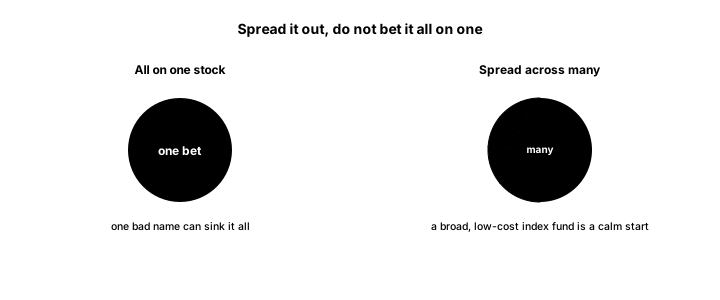
Diversify. Spread across several holdings so no single company can sink you. For most beginners, a broad index fund is the simplest way to own the whole market at once instead of betting on single stocks.
Invest regularly and hold. A fixed amount every month, left to compound over years, quietly does the heavy work and takes the emotion out of timing.
Ignore the noise. Skip the tips, sit out the daily drama, and steer around the mistakes and scams the last chapters described.
What to expect early on
Be honest with yourself about the first year, because false expectations are what drive beginners to quit at the worst moment. Your portfolio will rise and fall, and it may well be down at some point in the first year. That is normal, and it is not a sign you did anything wrong. Wealth here is built over years and decades, not weeks. Early on, how much you add matters far more than what you earn, so your consistency counts for more than any clever pick. Do not check the price ten times a day, because that only feeds the emotions your plan exists to overrule. Expect to feel fear when the market falls and greed when it soars, and let the plan decide, not the feeling.
Start small, and keep learning
There is no need to begin with large sums. Start small, get comfortable with the mechanics of accounts and orders, and scale up as your confidence grows, since mistakes are cheaper when the amounts are small. Niota's app lets you practise in a sandbox, so you can rehearse placing orders and watch how a position behaves without risking real money while these ideas are still fresh. Use it until the mechanics feel like second nature.
When you are ready to go beyond owning shares, the next course, Options Basics, opens up options, a different and more advanced instrument, taught from absolute zero in the same patient way this course was.
What to carry forward
Your first portfolio is built on a plan rather than a tip. Cover your foundation, invest long-horizon money, choose your risk on purpose, diversify, add to it regularly, hold through the swings, and tune out the noise. Expect the ride to be bumpy, judge your progress in years, and let your written plan lead when your feelings would rather not. This is the foundation the rest of your investing life is built on.
From here, two paths open. Practise the mechanics in the sandbox until they are second nature, and when you are ready, begin Options Basics, the next course, to learn a new set of tools from the ground up.