Course contents
Corporate actions
Corporate actions are company decisions that touch every shareholder. Dividends and buybacks return value; splits and bonuses reshape your holding without changing its total worth.
- Define dividend, stock split, bonus issue, and buyback
- Show what each does to your shares with a worked example
- Clear up the confusion that a split or bonus makes you richer
One morning your holding has changed and you did nothing. Perhaps some cash has appeared in your account. Perhaps you suddenly own twice as many shares, each worth half as much as yesterday. You placed no order. What happened is a corporate action, a decision by the company that reaches into every shareholder's account at once. Four of them are worth knowing well.
A corporate action is a step a company takes that directly affects its shares or its shareholders. It applies to everyone who owns the stock, and it is not something you start. Two kinds return value to you, and two reshape your holding without adding value by themselves. Keeping that division in mind is the key to not being fooled by any of them.
Dividends: cash from profit
A dividend is a share of the company's profit paid out to shareholders in cash. The company decides to distribute some of its earnings, and you receive a set amount for each share you hold. A five-rupee dividend on your hundred shares puts five hundred rupees in your bank.
Two honest notes. Many companies pay no dividend at all, choosing to reinvest their profits into growing the business, which is not a bad thing. And a dividend is not free money falling from the sky: when it is paid, the share price typically eases by about the dividend amount, because that cash has left the company and moved into your pocket. You are being handed a portion of what you already owned.
Stock splits: more slices, same pie
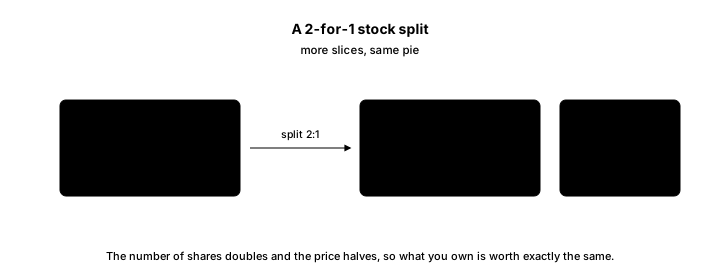
A stock split divides each existing share into several, each proportionally cheaper, leaving the total value you hold unchanged. In a one-to-two split, each one-thousand-rupee share becomes two five-hundred-rupee shares. You now hold twice as many shares at half the price, and your total is exactly the same as before. Nothing was created. The same pie was simply cut into more slices.
Companies split their shares to bring the per-share price down to a more approachable level, which can widen the base of small investors and improve liquidity. The classic beginner error is to feel richer after a split, or to see the now lower priced share as a bargain. It is neither.
Bonus issues: extra shares from reserves
A bonus issue gives existing shareholders additional shares at no cost, in proportion to what they already hold, drawn from the company's accumulated reserves. A one-to-one bonus hands you one extra share for every share you own. As with a split, the price adjusts downward so that your total value does not change. The technical difference is that a split simply re-divides existing shares while a bonus issues new ones from reserves, but the visible effect on you is much the same: more shares, a proportionally lower price, and the same total worth. A bonus is not free money either.
Buybacks: returning cash by shrinking the count
A buyback is the reverse of issuing shares: the company uses surplus cash to buy some of its own shares back from the market and cancel them. With fewer shares outstanding, each remaining share represents a slightly larger slice of the company. It is a second way, alongside dividends, for a company to return value to its owners. You can offer your shares into a buyback, often at a price above the market, or simply hold and benefit from owning a bigger slice of the whole.
What to carry forward
Four corporate actions cover most of what you will meet. Dividends and buybacks are the two genuine ways value comes back to shareholders, one as cash from profit, the other by shrinking the share count so each slice grows. Splits and bonuses change how many shares you hold and the price of each, but not your total value, which is the fact that defends you against feeling richer for no reason. When any of them happens, find the number that stays constant, and you will not be confused.
That completes the picture of reading and understanding price. The final part of the course turns practical and personal: how to begin investing safely. It starts with the relationship that sits underneath every decision you will make, the trade between risk and return.