Course contents
How an order works
An order joins the exchange's live order book of bids and asks, and a trade happens when a buyer and a seller agree on a price. A share's price is just the latest agreement.
- Define an order and the order book
- Explain how a buyer and a seller are matched
- Understand that a share's price is simply the latest agreed trade
You tap buy on ten shares. A price flashes, the trade is done in about a second, and the shares are yours. It feels like buying anything else online. But something more interesting happened in that second. Your order did not go to the company, and it did not go to a shop with a fixed price tag. It joined a live, two-sided auction and was matched against someone willing to sell.
The order book
An order is your instruction to buy or sell a set number of shares of a particular company, sent to the exchange through your trading account. That is all it is: a clear instruction, with a quantity and a company attached.
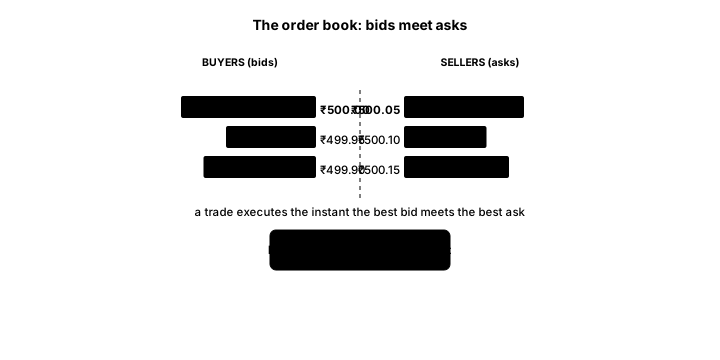
The exchange keeps, for every listed stock, a live and constantly changing list of all the orders waiting to be filled. This is the order book. On one side are the buyers, each stating the highest price they are willing to pay, which is called a bid. On the other side are the sellers, each stating the lowest price they will accept, called an ask or an offer. The order book is simply these two queues, sorted by price, updating many times a second.
A trade happens the instant a buyer and a seller agree on a price. When the most a buyer will pay meets the least a seller will accept, the two orders match and a trade executes, for that quantity, at that price. The exchange's computers do this automatically and continuously, pairing off orders in fractions of a second, thousands of times over.
Price is just the latest agreement
This leads to one of the most useful ideas in the whole course, and it is worth saying plainly. The price of a share is nothing more than the price at which the most recent buyer and seller agreed. No one hands it down from above. The company does not set it. It is the running record of the latest handshake between two willing people, updated with every single trade.
The small gap between the best bid and the best ask, five paise in that example, is called the spread. A heavily traded stock with many buyers and sellers has a tiny spread. A thinly traded one, with few participants, can have a wide spread, which is the liquidity idea from earlier chapters showing up in the price you actually get.
What to carry forward
When you place an order, it joins the exchange's order book, a live two-sided queue of bids from buyers and asks from sellers. A trade executes the moment the two sides agree on a price, matched automatically in a fraction of a second. From this comes the one idea to hold on to: the price of a share is just the latest handshake between a buyer and a seller, forever being updated, never handed down by anyone in charge.
You have seen that an order can either take the best price on offer right now, or wait for a price you name. That choice is the order type, and it is where the next chapter goes.