Course contents
The demat and trading account
To buy shares you need a trading account to place orders and a demat account to hold them, both linked to your bank. Opening them is a one-time KYC process.
- Define a demat account and a trading account and how they differ
- Explain how the two accounts connect to your bank
- Describe what you need to open them
You have decided to buy your first share. You download an app, and before anything works, three things have to be in place and talking to one another: your bank account, a trading account, and a demat account. The mystery clears the moment you see what each one does.
Two accounts, two jobs
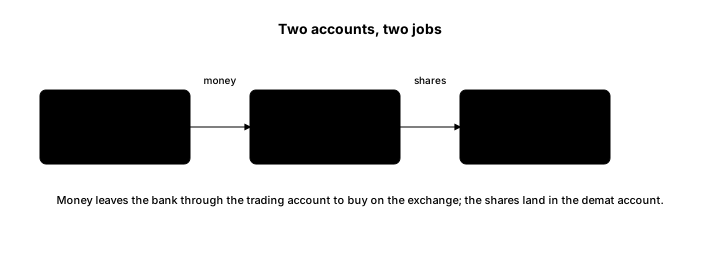
A trading account is the account through which you place your buy and sell orders on the exchange. It is the doorway to the market. When you tap buy, the instruction leaves your trading account and travels to the exchange, as the next chapter describes.
A demat account holds your shares. The word is short for dematerialised, which points to its history. Shares were once paper certificates you had to store and protect. Today they are electronic, and a demat account holds them in electronic form the way a bank account holds money. When you buy, shares arrive in your demat. When you sell, they leave it.
Your bank account holds your money, and it links to the other two. Put the three together and every trade is just a coordinated movement across them. When you buy, money leaves your bank and shares arrive in your demat. When you sell, shares leave your demat and money returns to your bank. Your trading account is what sends the orders that set all this in motion.
Tying it together is a broker, a SEBI-registered company or app that gives you the trading account, connects you to the exchange, and helps you open the demat account. The shares themselves sit with a depository, one of the two national bodies that keep electronic share records in India, and your demat account is simply your account there, reached through your broker. You will rarely deal with the depository directly.
What it takes to open one
Opening these accounts is a one-time process built around KYC, short for Know Your Customer, the identity check the law requires before you can trade. In practice you will need your PAN card, which is mandatory, a proof of identity and address such as Aadhaar, a linked bank account, a photograph, and your signature. Most brokers let you finish the whole process online in a day, and once done it does not need repeating.
What to carry forward
Buying shares takes two accounts working alongside your bank: a trading account that places your orders and a demat account that holds your shares in electronic form. A SEBI-registered broker ties them together and connects you to the exchange, and opening them is a one-time KYC process centred on your PAN. Use only registered brokers, guard your login details, and treat the account as the doorway, not the destination.
With the accounts open, the next question is what actually happens in the second after you tap buy. The next chapter opens that box: how an order works.