Course contents
What is an index
An index is a single number that summarises how a basket of important stocks is doing. The Nifty 50 and the Sensex are India's headline indices.
- Define a stock market index
- Explain the Nifty 50 and the Sensex in plain terms
- Explain what people mean when they say the market was up or down
Every evening the news delivers a verdict on the day: the market rose, or the market fell by a few hundred points. But a moment's thought raises a puzzle. There are thousands of listed companies, and on any given day some of their shares go up while others go down. So what single thing rose or fell? The answer is an index.
A number that stands for many
An index is a single number that tracks the combined value of a chosen basket of stocks, so that you can see at a glance how that whole group is doing without watching every share in it. It is a summary, a thermometer for one slice of the market. When the basket is worth more today than yesterday, the index number rises. When it is worth less, the number falls.
India has two headline indices, and you will hear their names constantly. The Nifty 50 is an index of fifty of the largest and most actively traded companies on the NSE, drawn from across the major industries. The Sensex is an older index of thirty large companies on the BSE. Because both track big, well-established companies, they usually rise and fall together, and either one is widely used as shorthand for the Indian stock market as a whole.
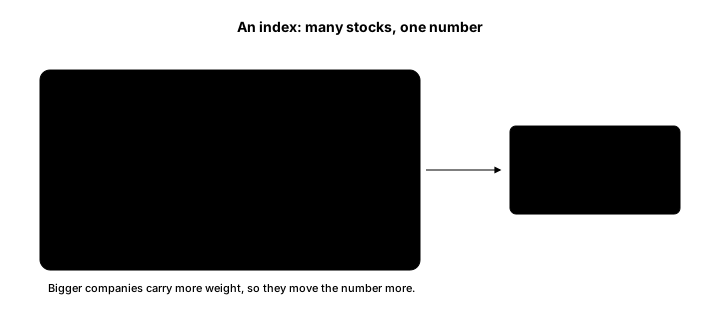
You do not need the arithmetic to use an index, but one detail is worth knowing: the companies in it are not counted equally. Larger companies carry more weight, so a move in a giant company nudges the index more than the same move in a smaller one. The practical meaning is simple. When the Nifty is up one percent, the basket of India's fifty biggest companies is worth about one percent more today than yesterday, on a size-weighted average.
What it means when the market is up
So when the news says the market rose, it almost always means a major index like the Nifty or the Sensex rose. And because an index is an average, it hides a great deal. On a day the Nifty closes higher, plenty of individual stocks still fell. The index tells you the mood and direction of the large-company market taken as a whole. It does not tell you what happened to any single share, including the ones you might own.
Indices are useful to an ordinary investor in three ways. They are a benchmark: at the end of a year you can ask whether your own investments did better or worse than the index, which is a fair and honest scorecard. They offer a simple way to invest in the broad market at once, through funds built to mirror an index, so you own a little of everything in the basket rather than betting on single stocks. And they are the shared pulse that the news, the professionals, and the whole market watch together.
What to carry forward
An index packs the performance of a whole basket of stocks into one number, so a single figure can stand in for a slice of the market. India's headline indices are the Nifty 50 on the NSE and the Sensex on the BSE, both tracking large, well-known companies, which is why the news treats them as the pulse of the market. When you hear that the market rose or fell, it is almost always one of these, and it is an average that can hide as much as it reveals.
That closes the picture of what the market is and how it is put together. The next part gets practical. Before you can buy a single share of any of these companies, you need two accounts and a little know-how, and that is where the next chapter begins.