Course contents
Exchanges and SEBI
Listed shares trade between investors on stock exchanges like the NSE and BSE, under the rules of the market regulator, SEBI.
- Define the secondary market and the role of a stock exchange
- Identify the NSE and BSE and what an exchange provides
- Explain what SEBI does and why a regulator protects you without guaranteeing profit
Once a company's shares are listed, something remarkable has to happen every second the market is open. Lakhs of strangers, spread across the country, need to buy and sell the very same shares from each other, at a fair price, and trust that the deal will actually go through, all without knowing one another personally. That only works because they are not meeting in the open. They are meeting inside an organised, tightly governed marketplace, a stock exchange, watched over by a regulator.
Where listed shares trade
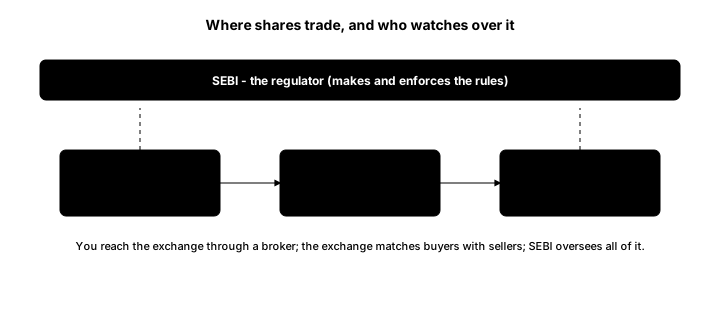
The last two chapters described the primary market, where a company sells new shares and receives the money. Almost all the trading you will ever do happens somewhere else, in the secondary market: the buying and selling of already-issued shares between investors. When you buy a listed share, you are almost always buying it from another investor, not from the company. Your money goes to the seller. The company is not part of the transaction.
The secondary market needs a venue, and that venue is a stock exchange: an organised marketplace that matches buyers with sellers, publishes live prices for all to see, and guarantees that trades complete. India has two main exchanges. The National Stock Exchange, the NSE, is the larger by trading volume. The Bombay Stock Exchange, the BSE, is the older, in fact one of the oldest in Asia. Most well-known companies are listed on both, and a share bought on one is the same ownership as a share bought on the other.
What the exchange gives you
An exchange does three quiet but essential things.
It provides liquidity, the idea from chapter two. Because so many buyers and sellers gather in one place, you can usually turn shares into cash, or cash into shares, quickly and at a fair price.
It provides fair price discovery. With many participants openly bidding and offering, the price of a share at any moment reflects the balance of everyone's willingness to buy and sell, rather than one party's say-so.
And it provides safety. Through a connected clearing and settlement system, the exchange stands in the middle of every trade and makes sure that when you pay, you receive your shares, and when you sell, you receive your money, even if the anonymous person on the other side fails to honour their end. How that settlement works has its own chapter later.
The referee: SEBI
A marketplace this large, with this much money moving through it, attracts not only honest participants but also people who would manipulate or defraud it. That is why the market has a rule-maker and referee: the Securities and Exchange Board of India, or SEBI.
SEBI's job is to protect investors and keep the market fair, orderly, and transparent. It requires listed companies to disclose their finances and material news honestly and on time, so that investors decide on facts rather than rumour. It licenses and supervises the intermediaries you rely on, such as brokers and the exchanges themselves. And it investigates and punishes fraud, insider dealing, and manipulation. Think of SEBI as the body that both writes the rules of the game and enforces them.
Here is the part to understand clearly. SEBI makes the game fair. It does not make it safe from loss. It ensures companies tell the truth and that no one is cheating you, but it does not promise that any particular company is a good business or that your investment will make money. A fair game is not the same as a winning one. You can lose money on a completely legitimate, fully regulated share simply because the business behind it did poorly, and that loss is yours, not a failure of regulation.
What to carry forward
After a company lists, its shares trade in the secondary market, between investors, on organised stock exchanges. India's two main ones are the NSE and the BSE, and for most companies a share on one is the same as a share on the other. The exchange gives the market liquidity, fair price discovery, and the settlement machinery that lets strangers trade safely. Above all of it sits SEBI, the regulator that enforces honest disclosure and fair conduct, while leaving the question of profit or loss squarely with you.
You now know where shares trade and who keeps the trading fair. The next chapter zooms out from single stocks to the whole market, and explains the numbers you hear every evening on the news: the Nifty and the Sensex.