Course contents
What moves a price
A price moves only when the balance of buyers and sellers shifts, pushed by company news and earnings, the wider economy, and human mood, and it turns on surprises versus expectations.
- Explain supply and demand for a single stock
- Connect news, earnings, and expectations to price moves
- Explain sentiment honestly, and why short-term moves are largely noise
A stock sits quietly at five hundred rupees for a week, then leaps to five hundred and forty one morning after the company reports strong results. On another day it drifts lower for no reason you can find in the news. What actually moves a price? The answer is not mysterious, and it follows straight from how trades happen.
The engine: supply and demand
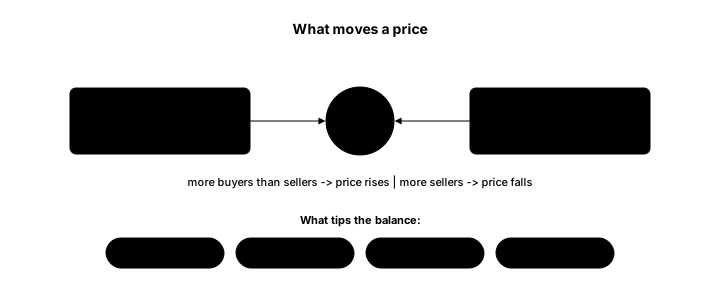
Recall the anchor idea: a price is where a buyer and a seller agree. So a price can only move when that balance shifts. If, at the current price, more people want to buy than to sell, buyers have to offer a little more to tempt sellers out, and the price rises. If more want to sell than to buy, sellers have to accept a little less to find buyers, and the price falls. That is the whole engine. Demand is the crowd's willingness to buy, supply is its willingness to sell, and every price move you will ever see is those two rebalancing.
What tips the balance
The interesting question is what makes a crowd suddenly want to buy or sell. Three forces do most of the work.
The first is company news and earnings, which are the company's profits, reported every quarter. When a company reports its results, wins a large order, launches something, or changes its leadership, the market re-weighs what the business is worth, and buyers or sellers move in. Strong news tends to bring buyers, weak news tends to bring sellers.
But here is the twist that surprises every beginner. What moves a price is not the news itself, but the news measured against what people already expected. A price already reflects the market's expectations. So a company can report record profits and still fall, if those profits were merely good when the market had hoped for spectacular. The surprise is what moves the price, not the raw fact.
The second force is the wider world: interest rates, government policy and budgets, global events, the fortunes of an entire industry. These tend to move whole groups of stocks together, or the market as a whole, which is what an index measures.
The third is plain human mood, the swing between greed and fear. Sometimes prices move on how people feel rather than on any new fact. A wave of optimism can lift a stock past what the news justifies, and a wave of fear can push it below. This is not mystical. It is the same supply and demand, driven by emotion instead of information.
What to carry forward
A share price changes only when demand and supply rebalance, and that balance is tipped by company earnings and news, by the broader economy, and by the mood of the crowd. The subtle part, worth holding on to, is that prices respond to surprises rather than to news in the abstract, since expectations are already baked into the price. That is why a strong result can still be met with a falling stock. In the short run price is noisy and unpredictable, but over the long run it tracks the actual business, which is exactly why the earlier chapters kept returning to patience.
Knowing why a price moves, the next chapter adds a number that puts any price in perspective and tells you how big the company behind it really is: its market capitalisation.