Course contents
What is a share
A share is a unit of ownership in a real business. Own one and you are a part owner, with a proportional claim on the company's profits and its future.
- Define a share, a shareholder, and equity
- Contrast owning a business with lending to it
- Work a simple ownership example with real figures
Picture three friends who decide to open a small bakery. Setting it up (the oven, the shopfront, the first sacks of flour) costs nine lakh rupees. None of them has that alone, so they split it: each puts in three lakh rupees, and in return each owns one third of the bakery. That one third is their share of the business. It is not a piece of paper they care about. It is a claim on something real: a third of the profits when the bakery does well, a third of the say in how it is run, and a third of the money if they ever sell the place.
Own a share of a company and you own exactly this kind of claim, usually just a much smaller slice of a much larger business.
Ownership, cut into slices
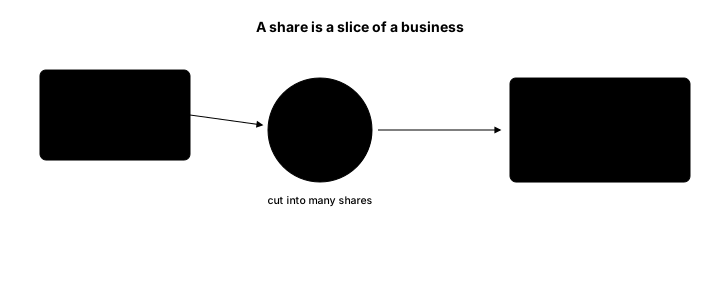
A share is a unit of ownership in a company. Buy one and you become a shareholder, which is simply a part owner. The whole of a company's ownership is called its equity, and that equity is divided into shares. When you hold shares, you own a slice of everything the company is and everything it becomes: its shops and factories, its brand, the cash in its accounts, and above all its future profits.
A listed company, one whose shares you can buy on the market, works exactly like the bakery, only cut into far more slices. Instead of three friends holding three shares, a large Indian company might be divided into crores of shares held by lakhs of people. Buy a hundred shares and you hold a hundred tiny slices, with the same rights the three friends had, shrunk to your size: a proportional claim on the profits, a proportional vote, and a proportional stake in whatever the business grows into.
Ownership entitles you to a few things worth naming now, even though each has its own chapter later. The first is a share of the profits the company chooses to hand back to its owners, a payment called a dividend. The second is a vote on certain decisions, one vote per share, which for a small holder is real but rarely decisive. The third, and the one most investors actually care about, is a claim on the value of the business itself. If the company grows and becomes worth more over time, each slice of it is worth more too, and that shows up in the share price.
Owning is not the same as lending
Here is the distinction that clears up most confusion about shares. There are two very different ways to put money into a company, and they sit on opposite sides of a line.
You can lend to it. If you hand a company money as a loan, often by buying something called a bond, you are a lender, not an owner. The company promises to pay you a fixed rate of interest and to return your money on an agreed date, whether it has a wonderful year or a terrible one. In exchange for that safety, you get none of the upside. If the business triples in value, your loan still just pays its agreed interest and comes back. Lending to a company is its debt.
Or you can own part of it, by buying shares. As an owner you get no promise of a fixed return and no fixed date to get your money back. If the company does badly you can lose, and if it fails you are last in line, paid only after the lenders and others are settled. But you also get the full share of the upside. When the business grows, the owners are the ones who gain. Owning part of a company is its equity.
So the same company can offer you two different deals: lend to it and take a smaller, safer, fixed return, or own part of it and take a larger, riskier, open-ended one. A share is always the second deal. This is the trade at the centre of the last two chapters, seen from the inside: the reward you are offered for accepting risk.
Be clear about what you do and do not own
What to carry forward
A share is a unit of ownership in a company, and holding one makes you a part owner with a proportional claim on its profits and its future value. Equity means ownership, which carries both the upside and the risk. Debt means lending, which carries a fixed return and less risk. The worth of your share rises and falls with the business itself, and with what other people will pay you for your slice, a point the coming chapters return to often.
If owning a share is owning a piece of a company, two natural questions follow. Where do these shares come from in the first place, and why would a company sell pieces of itself to strangers at all? The next chapter answers both, starting with the choice every growing company faces: borrow the money, or sell a part of itself.