Course contents
Your return is what you keep
The only return that matters is what you keep after tax and costs, and both are larger than beginners expect. Understanding tax is not optional paperwork; it protects your real returns and keeps you out of trouble with the tax department.
- Frame after-tax, after-cost return as the only return that matters
- Explain that tax non-compliance carries real consequences beyond money
- Set the honest, educational-not-advice, confirm-the-current-law tone for the whole course
A beginner finishes the year, adds up the trades, and sees a profit of one lakh rupees. A good year, they think. Then the real number arrives. After the brokerage, the securities transaction tax, and the other charges every trade paid, and after the income tax due on what is left, the amount that actually stays in their hands is closer to fifty-six thousand. The one lakh was never really one lakh. It was the figure before the two forces that quietly take a share of every market return: costs, and tax. This course is about the second of those forces, and about keeping more of what you earn by understanding it.
The only return that matters
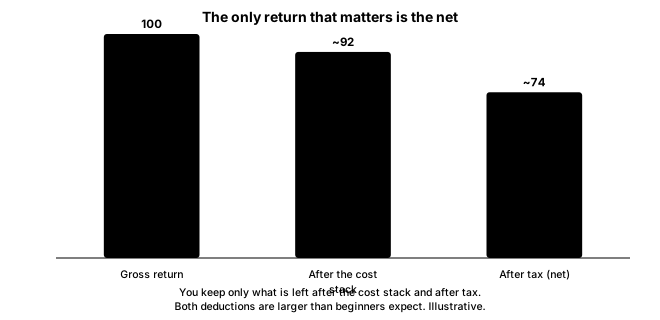
Every other course in this catalogue helps you make a gross return, the profit before costs and tax. This one is about the return that actually reaches your bank account, the net return after both are paid, because that is the only number you can spend. A strategy that looks wonderful on gross profit can be ordinary once costs and tax are counted, and beginners routinely overestimate their real returns by ignoring exactly the amounts this course covers.
Watch how the gap opens on that one lakh of gross profit. Suppose your trading costs for the year came to about twenty thousand rupees, the kind of drag the Risk and Psychology course warned that active trading carries. That leaves eighty thousand of actual, taxable profit. If that profit is taxed at, say, a thirty percent rate (illustrative, and the rates are covered properly later), a further twenty-four thousand goes in tax, leaving about fifty-six thousand. So a little over half of the headline profit is what you keep. Neither costs nor tax is optional, and neither can be wished away, so the sooner you count them honestly, the more realistic, and the more protected, your expectations become.
Tax is not just paperwork
There is a second reason to take tax seriously, beyond the money, and it is the one beginners underrate most. Getting your tax wrong does not merely cost you a little extra. It can bring a notice from the Income Tax Department, interest and penalties on what was unpaid, and a great deal of stress and time to set right. The department today receives detailed information about your market activity directly from exchanges, brokers, and mutual funds, so income you did not report is often already known to it. Non-reporting is not a gap the department cannot see; it is a mismatch waiting to be flagged.
The good news is that compliance is entirely learnable, and it is mostly a matter of understanding a handful of rules and keeping decent records. A trader who knows how their income is classified, pays advance tax through the year, and files the right return on time has very little to fear. This course is designed to make you that trader.
How to read this course
Two honest cautions shape everything that follows, and they are important enough to state at the very start.
First, tax law changes. India revises its tax rules almost every year in the Union Budget, so specific rates, thresholds, holding periods, audit limits, forms, and due dates go out of date quickly. This course therefore teaches the framework and the mechanics, which change slowly, rather than numbers to memorise. Wherever a specific figure appears, treat it as illustrative and confirm the current rule, for the relevant year, before you act on it.
Second, this is education, not tax advice. It will make you an informed participant who understands their own position and asks the right questions, but it cannot replace advice tailored to your situation. For your actual return, and for anything beyond the basics, a qualified chartered accountant is worth far more than they cost.
What to carry forward
The return that matters is the one you keep after costs and tax, which is often far less than the headline profit, so counting tax honestly is part of realistic investing, not an afterthought. Tax also has to be got right, because the department can already see your activity and mistakes bring real trouble, but compliance is learnable. Above all, read this course as a framework to understand, with every specific figure confirmed against the current year's law, and as education rather than tax advice.
To understand how your market income is taxed, you first have to see how Indian tax law sorts income at all. The next chapter introduces the heads of income and shows where a trader's and an investor's money lands.