Course contents
Gain, cost, and the holding period
A capital gain is the profit from selling a capital asset, and computing it means knowing the sale value, the cost of acquisition, and how long you held the asset. The holding period, short or long, then decides how it is taxed.
- Define a capital asset, capital gain, cost of acquisition, and sale consideration in plain terms
- Define the holding period and the split into short-term and long-term
- Work a simple gain calculation with illustrative figures
You sold some shares at a profit, and now you want to know the tax. Before any rate can be applied, you need just three facts about the sale: how much you received, how much the shares had cost you, and how long you had held them. Those three numbers define your capital gain and decide which kind of gain it is, and getting them right is the whole of this chapter. The rates themselves come next.
The pieces of a capital gain
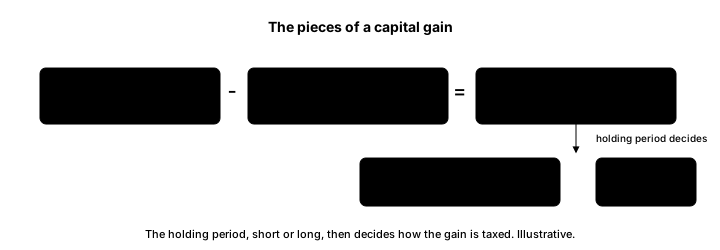
A capital asset is, broadly, property you hold as an investment: shares, mutual fund units, property, gold, and the like. A capital gain is the profit you make when you sell one for more than it cost you. Two figures define it.
The sale consideration is what you received on selling, the sale price times the quantity. The cost of acquisition is what you originally paid to buy it, including the purchase price and the costs of buying, such as brokerage. The gain is simply the first minus the second, and you may also subtract the direct expenses of transfer, the brokerage and charges on the sale itself.
Work it through. Suppose you bought 100 shares at 500 rupees each, a cost of 50,000, and later sold all 100 at 700, receiving 70,000. Your capital gain is 70,000 minus 50,000, or 20,000 rupees, before adjusting for the small charges on either side. (All figures illustrative.) If instead you had sold below your cost, the same subtraction would give a capital loss, which, as a later chapter shows, is not wasted but can be set off against other gains.
The holding period, and why it splits the gain
The size of the gain is only half the story. How it is taxed depends heavily on how long you held the asset before selling, a span called the holding period. Tax law draws a line at a certain length of holding and splits capital gains into two kinds on either side of it.
A short-term capital gain, or STCG, arises when you sell within the holding-period line, having held the asset only a short time. A long-term capital gain, or LTCG, arises when you sell after holding beyond that line. The two are taxed under different rules, and long-term gains are generally treated more gently, which is the tax system's way of rewarding longer holding.
The exact length of that line differs by the type of asset, and it is one of the figures that changes and must be confirmed against the current law. For listed shares and equity mutual funds it is commonly a holding of about twelve months, while for many other assets it is longer. The point to carry is the structure: find your gain, then check which side of the holding-period line your holding falls on, because that decides everything about the rate.
Cost is not always just what you paid
One honest complication, which later chapters return to. For some assets and some situations, the cost of acquisition is adjusted rather than taken at the raw purchase price: very old equity holdings carry a special protected cost from a cut-off date, and some non-equity assets were historically allowed an inflation adjustment to their cost. These adjustments change with the law and differ by asset, so treat the plain "sale minus cost" here as the core idea, and expect the equity and other-asset chapters to refine the cost figure where the rules require it.
What to carry forward
A capital gain is what you sold an asset for, minus what it cost you and the charges on the sale, and how that gain is taxed turns on the holding period: short-term if you sold within the line, long-term if you held beyond it, with long-term generally treated more kindly. The exact holding-period line, and some cost adjustments, differ by asset and change with the law, so they are figures to confirm, not memorise.
That is the general machinery of a capital gain. The next chapter applies it to the asset most readers care about most, listed shares and equity mutual funds, which carry their own special and generally favourable rates.