Course contents
Paying tax as you earn
India expects tax to be paid through the year, in quarterly instalments of advance tax, not in a lump sum at filing, and traders with gains or business income who ignore this face interest penalties. It is one of the most common and avoidable traps.
- Explain advance tax and the quarterly instalment schedule
- Explain the interest charged for shortfall or delay at a beginner level
- Show why market income makes advance tax easy to underpay
A salaried person rarely thinks about advance tax, because their employer quietly deducts tax from each month's salary and pays it to the government through the year. A trader has no such employer, and their income arrives in lumps, so a duty that salary-earners never notice lands squarely on them, and catches them out year after year. India expects tax to be paid as income is earned, through the year, not saved up and paid in one lump at filing, and the mechanism for that is advance tax.
What advance tax is
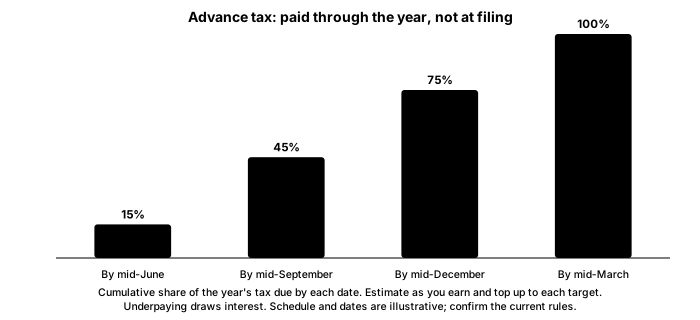
Advance tax is income tax paid during the financial year in which the income is earned, rather than after it ends. If your total tax for the year, after accounting for any tax already deducted at source, is expected to exceed a small threshold, illustratively 10,000 rupees, you are required to pay it in instalments as you go. For a trader or investor with meaningful gains or business income and little TDS, that threshold is easily crossed, so advance tax usually applies.
It is paid on a fixed quarterly schedule, with each instalment a cumulative share of your estimated tax for the year. Illustratively, the targets are about 15% of the year's tax by mid-June, 45% by mid-September, 75% by mid-December, and the full 100% by mid-March. You estimate your tax for the year, and top up to each cumulative target by its date.
The interest for getting it wrong
If you underpay or skip advance tax, the law charges interest on the shortfall, under two provisions worth knowing by name. One charges interest when you have not paid enough advance tax by the end of the year, and the other charges interest when you miss or underpay the individual quarterly instalments. The rate is modest but real, illustratively around 1% a month on the shortfall, and it runs until you pay. It is not a harsh penalty, but it is an avoidable cost, and avoiding it is simply a matter of paying as you go.
Follow it through. Suppose your net trading profit for the year is 3,00,000 rupees and your slab works out to 30%, so your tax is about 90,000, with no TDS to cover it. You are expected to pay that 90,000 across the year: roughly 13,500 by mid-June, 40,500 in total by mid-September, 67,500 by mid-December, and the full 90,000 by mid-March. Pay nothing until filing, and interest accrues on the amounts that should have been paid at each stage. (All figures illustrative.)
Why traders get caught
Three things make advance tax a trap specifically for market participants. Their income is not covered by the automatic salary TDS that quietly handles it for employees, so nobody is paying it on their behalf. It is lumpy and unpredictable, a big gain in one quarter and a loss in the next, which makes it easy to put off estimating. And a good run can hide the obligation, because the tax on a profitable quarter is due long before the year's final result is known. The result is a trader who has a profitable year, pays no advance tax, and meets both a tax bill and an interest charge at filing.
The habit that prevents all of this is simple: treat a profitable quarter as triggering a tax payment. Estimate the tax on your gains as you make them, set that money aside rather than redeploying it, and pay each instalment by its date. Tax set aside through the year is money you never really had to spend, and paying it on schedule costs you nothing extra, while ignoring it costs you interest and a nasty surprise.
What to carry forward
Tax is meant to be paid through the year as advance tax, in quarterly instalments building to the full amount by March, once your yearly tax crosses a small threshold, and underpaying draws interest. Traders are caught because their income has no salary TDS, arrives in lumps, and a profitable quarter's tax is due long before the year's result is known. The fix is a habit: treat each profitable quarter as a tax payment, set the money aside, and pay on schedule.
That completes the shared machinery of losses, costs, and advance tax. Part 5 turns the whole course into action: which return to file and how, the common mistakes that bring notices, investing tax-aware without distorting good decisions, and when to bring in a professional.