Course contents
Short-term and long-term on shares
Listed shares and equity mutual funds on which STT is paid are taxed under special rules, with one holding period splitting short-term from long-term gains and each taxed at its own rate, subject to an annual exemption on long-term gains. The exact periods and rates must be confirmed against the current law.
- Explain the holding-period split and the special STT-paid rates for STCG and LTCG on equity
- Explain the annual long-term exemption and the idea of grandfathering older gains
- Work an illustrative example, with every rate and threshold marked to confirm at publish
Listed shares and equity mutual funds get their own set of capital-gains rules, separate from every other asset, and on the whole those rules are favourable, which is one quiet reason long-term equity investing is tax-efficient. The catch, for a course written to last, is that the exact rates and thresholds in these rules are changed fairly often in the Budget, so this chapter teaches the durable structure and marks every specific number as one to confirm against the current law.
The condition, and the holding-period split
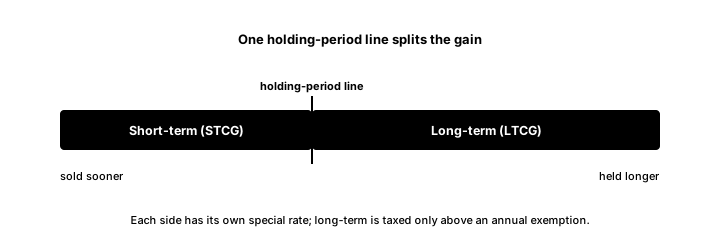
The special equity rules apply to listed shares and equity mutual funds on which the securities transaction tax, the STT you meet in a later chapter, has been paid, which covers ordinary market transactions. For these, tax law draws a single holding-period line, commonly a holding of about twelve months, and splits your gain in two.
Sell within that line and your profit is a short-term capital gain (STCG). Sell after holding beyond it and your profit is a long-term capital gain (LTCG). As the last chapter said, the long-term side is treated more gently, and for equity that gentler treatment takes a specific and useful shape.
The rates, illustratively
For STT-paid equity, each kind of gain has its own special rate, and these are the figures most likely to have moved since this was written, so read them as illustrative.
A short-term capital gain on equity is taxed at a special flat rate, illustratively 20%, applied to the gain regardless of your income slab. So on the 20,000 rupee gain from the last chapter, held six months, the tax would be about 4,000 at that illustrative rate. Note that this flat rate is not the same as your slab: for someone in a 30% slab it is lower, so the same 20,000 taxed as business income would cost about 6,000, one more reason the investor-or-trader classification matters.
A long-term capital gain on equity is taxed at a special rate, illustratively 12.5%, but only on the amount above an annual exemption, illustratively 1.25 lakh rupees of long-term equity gains each year. Suppose your long-term equity gains for the year total 3,00,000. The first 1,25,000 is exempt, leaving 1,75,000 taxable, and at the illustrative 12.5% the tax is about 21,875. That annual exemption resets every year, which, as a later chapter notes, is worth using deliberately rather than wasting.
Grandfathering, for older holdings
One more feature protects long-held shares from a rule change. When the tax on long-term equity gains was reintroduced, gains that had already built up before a cut-off date, the last day of January 2018, were grandfathered, meaning protected, so that only the growth after that date is taxed for holdings from before it. If you hold shares bought years before that cut-off, their taxable gain is measured from the protected value, not the original cost. For anything bought since, this does not arise, and the plain cost applies.
The durable point
Strip away the specific numbers, which you will confirm, and the structure is what to remember. STT-paid equity has a holding-period line; short-term gains are taxed at a flat special rate that ignores your slab; long-term gains are taxed at a lower special rate but only above an annual exemption that resets each year; and very old holdings enjoy grandfathering. That shape has held even as the exact rates moved, and it is what makes long-term equity investing relatively tax-friendly, so long as you confirm the current figures before you compute.
What to carry forward
For STT-paid equity, one holding-period line separates short-term gains, taxed at a flat special rate that ignores your slab, from long-term gains, taxed at a lower special rate but only above an annual exemption that resets each year, with very old holdings grandfathered. That favourable structure is durable even though the exact rates, illustrated here at 20%, 12.5%, and a 1.25 lakh exemption, change and must be confirmed at publish.
Gains arise when you sell, but holding equity also pays you along the way, in dividends, and other investments pay interest. The next chapter covers that income you earn simply for holding, and the surprise that it is not tax-free.