Course contents
The distinction that governs everything
The single most important tax question for a market participant is whether their activity is investing, taxed as capital gains, or trading as a business, taxed as business income. The answer changes the rates, the deductions, and the paperwork, so it deserves its own chapter.
- Explain the difference between capital gains and business income and why it matters so much
- Describe the factors that indicate investor versus trader treatment
- Flag that F&O and intraday are generally business income while long-held equity is generally capital gains, to be confirmed against current law
Two people spend the year buying and selling shares of the same companies. The first buys a few good businesses and holds them for months or years, selling rarely. The second is at the screen every day, buying and selling constantly, treating it as their work. In the eyes of tax law these two are doing different things: the first is an investor, taxed under capital gains, and the second is running a business, taxed under business income. That single distinction changes the rate they pay, the costs they can deduct, and the paperwork they must keep, which is why it is the most important tax question a market participant ever answers.
Two ways the same activity is taxed
The fork sits between two of the heads from the last chapter. If your market profits are capital gains, they are taxed under rules based on the type of asset and how long you held it, often at special rates that, for long-held equity, are lighter than ordinary rates. But as an investor you generally cannot deduct the running expenses of an activity, because you are not running one, and your paperwork is relatively simple.
If your profits are business income, under profits and gains of business or profession, they are added to your other income and taxed at your normal slab rates. In exchange for that, you may deduct the genuine expenses of the business, and you carry the duties of a business: keeping books, possibly a tax audit, and paying advance tax through the year. Business income also splits internally, as a later chapter explains, into speculative income (such as intraday equity trading) and non-speculative income (such as futures and options).
Neither treatment is simply better. Capital gains can mean a lower rate but no expense deductions; business income means slab rates but real deductions and more compliance. What matters is that they are genuinely different regimes, and you must know which one your activity falls under.
How the line is drawn
So how do you tell which you are? Tax law does not give a single clean rule, and instead weighs the facts of what you actually did. Several factors point one way or the other.
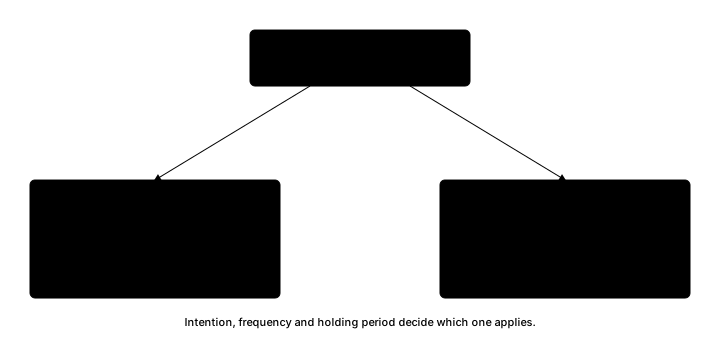
Your intention matters: whether you bought to hold an investment and earn from its growth and dividends, or to trade in and out for short-term profit. So does frequency and volume: an occasional buyer looks like an investor, while someone transacting constantly, in large volumes, looks like a business. Holding period is telling: assets held for a long time suggest investment, while rapid buying and selling suggests trade. And whether the activity is organised like a business, with borrowed money, systematic effort, and dedicated time, pushes it toward business income. No single factor decides it; the overall picture does.
The general pattern, and its grey area
Some cases are clear, and it helps to know them, though all of this must be confirmed against the current law and your own facts.
Futures and options trading is generally treated as business income, non-speculative, whatever your intention, because of its nature. Intraday equity trading, buying and selling the same shares the same day without taking delivery, is generally business income too, and specifically speculative. Shares and equity mutual funds you buy and hold as investments and sell after a long time are generally capital gains. The genuine grey area is frequent buying and selling of delivered shares, which can be argued either way and is judged on the overall facts.
Because the line is fact-specific and sometimes contested, two habits protect you. Be consistent: do not label the same kind of activity as investment in a good year and business in a bad one to suit the tax. And when your situation is genuinely unclear, especially if you both invest and trade, get a chartered accountant's view rather than guessing, because the classification cascades into everything else on your return.
What to carry forward
Whether your market income is capital gains or business income is the fork that governs everything else: it sets your rate, whether you can deduct expenses, and how much compliance you carry. The law judges it on the whole picture, your intention, frequency, holding period, and how business-like the activity is, with F&O and intraday generally business income and long-held equity generally capital gains, while frequent delivery trading is the grey area. Be consistent, and get advice when it is unclear.
With the fork understood, the course now follows each branch in turn. Part 2 takes the investor's branch first: how capital gains work, starting with the basics of what a capital gain even is.