Course contents
What you can deduct
Because trading as a business is taxed on its net profit, a trader can deduct the genuine expenses of the business, from brokerage and charges to a share of internet, devices, and advisory costs, arriving at the taxable figure. This is a real benefit of business treatment.
- Explain that business income is net of allowable expenses and list common deductible trading expenses
- Work an illustrative computation from gross trading profit to taxable business income
- Note the interaction with the old and new tax regimes, to be confirmed at publish
Business treatment brings real burdens, but it also brings a genuine advantage that a capital-gains investor does not get: because a business is taxed on its net profit, you may subtract the real costs of running your trading business before the tax is applied. For an active trader those costs add up, so the deduction is worth understanding and worth documenting. This chapter shows what you can deduct and how the taxable figure is built.
Taxed on net, not gross
The core idea is simple. Your taxable business income is not your gross trading profit but your gross profit minus the allowable expenses of earning it. An investor paying capital-gains tax is taxed on the gain itself with no deduction for their costs, but a trader with business income is taxed only on what is left after the genuine expenses of the trading business come off. That difference can matter a great deal over a busy year.
What counts as an expense
The expenses you may deduct are those genuinely incurred to earn the trading income. Common ones for a trader include the brokerage on your trades and the exchange, clearing, and regulator charges, the GST on those charges, and the securities transaction tax, which, notably, is an allowable business expense when your income is business income even though it is not deductible against capital gains. Beyond the trading charges, you can deduct a reasonable share of the costs that support the activity: your internet and phone, a portion of electricity, depreciation on the computer and devices you trade on, data and charting subscriptions, advisory fees, and any salary you genuinely pay for help.
Two conditions govern all of this. The expense must be genuine and actually incurred for the business, not a personal cost dressed up as one, and you must be able to show it, with records and receipts. A reasonable, documented share of a shared cost like electricity or a home internet line is fine; inventing expenses is not, and it is exactly the kind of thing that unravels under scrutiny.
From gross profit to taxable income
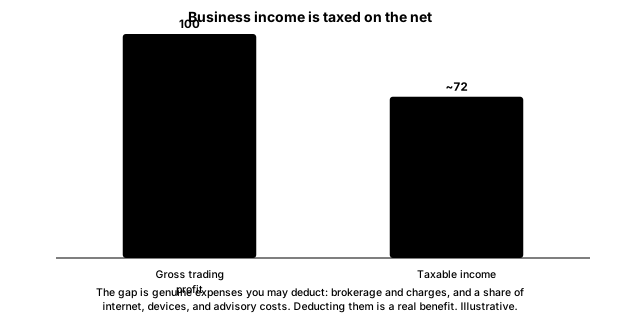
Put it together with an illustrative example. Suppose your F&O trading for the year made a gross profit of 5,00,000 rupees. Against it you can set brokerage and charges of 40,000, a reasonable share of internet and device costs of 20,000, and data and advisory subscriptions of 15,000, a total of 75,000 in expenses. Your taxable business income is then 5,00,000 minus 75,000, or 4,25,000, and it is that net figure, not the gross 5,00,000, that is added to your other income and taxed at your slab. (All figures illustrative.)
The regime question
One complication to flag rather than resolve, because it changes. India now has two tax regimes, an older one with many deductions and a newer one with lower slab rates but most personal deductions removed, and you choose between them. The expenses above are different from those personal deductions: they are the costs of computing your business income itself, and they are generally allowed in arriving at that income under either regime. But the choice of regime still affects your slab rates and which other deductions, such as certain investments and insurance, you can claim, so it changes your overall tax even when your business-expense deduction does not. Which regime suits you depends on your whole situation, and it is a sensible thing to settle with a chartered accountant.
What to carry forward
The advantage of business treatment is that you are taxed on net profit, so the genuine, documented costs of the trading business, brokerage and charges, STT, GST, and a reasonable share of internet, devices, depreciation, data, and advisory, come off before tax, turning a gross 5,00,000 into a smaller taxable figure. Keep records, claim only real expenses, and settle the old-versus-new regime question for your situation, ideally with professional help.
Business income also comes with duties, and one of them causes more needless panic than any other: turnover and the question of a tax audit. The next chapter explains why a trader's turnover is nothing like their contract value, and what the audit rules actually turn on.